Hostinger vs Bluehost 2026: Real Renewal Prices Compared
Hostinger offers better long-term value for most small WordPress sites. Bluehost is worth considering if you need phone support, more sites on the entry plan or one of its additional data center locations. Compare the full prepaid term and renewal bill before choosing.
Pricing: intro vs renewal, term by term
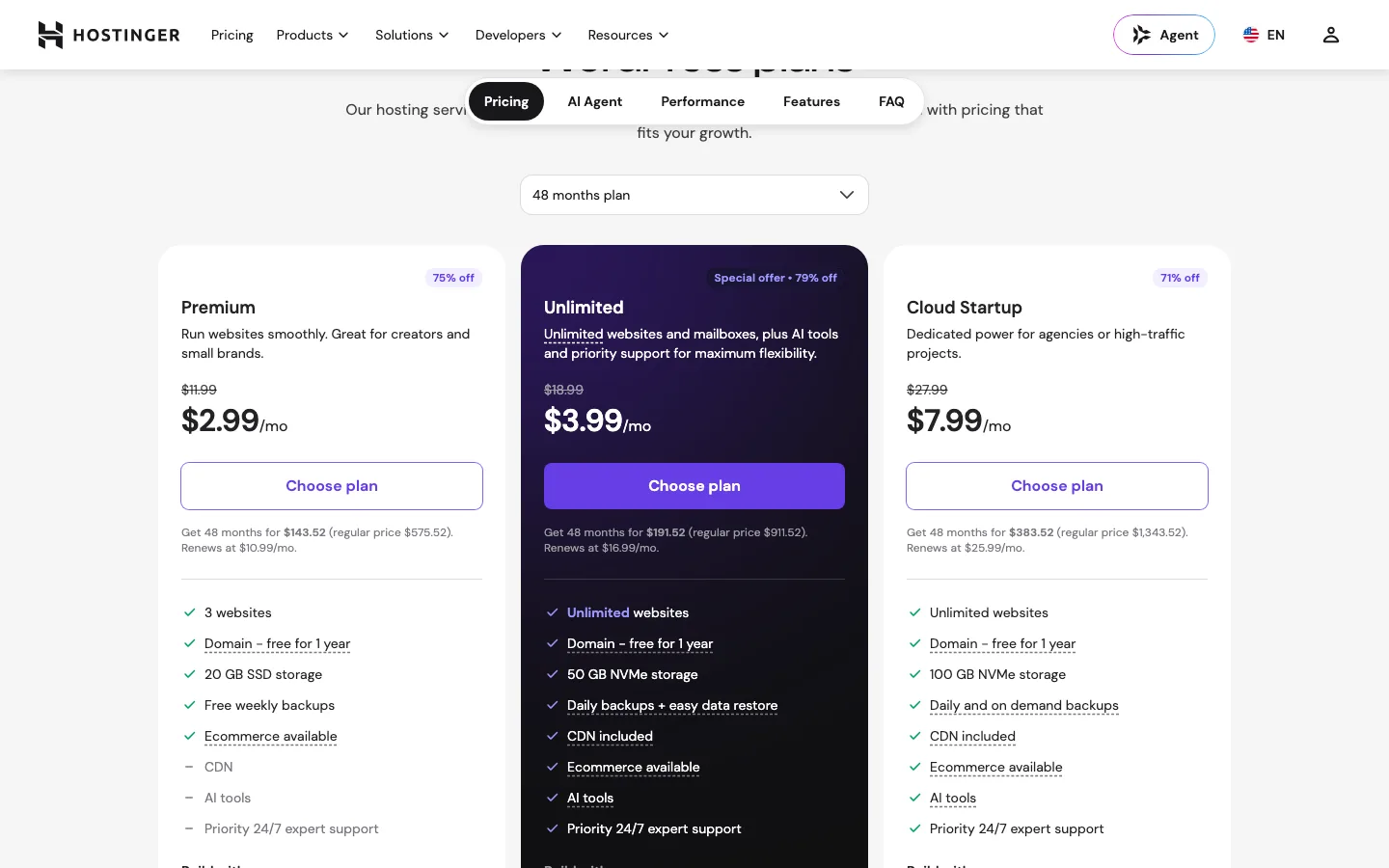
Hostinger’s WordPress hosting plans with the term menu set to 48 months. Premium shows CDN, AI tools and priority support as not included.
Both hosts bill the whole term upfront. The monthly figure on the pricing page is the total divided by the number of months. Hostinger says so on its pricing page. Bluehost’s User Agreement says all payments are taken in advance for the full term.
Hostinger prices
Premium costs $143.52 for 48 months, equivalent to $2.99 monthly. Shorter commitments cost $83.76 for 24 months at $3.49, $47.88 for 12 months at $3.99, or $11.99 month to month. Renewal is $10.99 monthly.
Unlimited costs $191.52 for 48 months at $3.99, $107.76 for 24 months at $4.49, or $59.88 for 12 months at $4.99. Monthly billing costs $18.99 and renewal $16.99.
Cloud Startup costs $383.52 for 48 months at $7.99, $215.76 for 24 months at $8.99, or $119.88 for 12 months at $9.99. Monthly billing costs $27.99 and renewal $25.99.
The renewal price is the same whichever long term you pick. The one-month plan renews at its own full price ($11.99 for Premium).
Bluehost prices
Bluehost Starter costs $143.64 for 36 months at $3.99 monthly or $59.88 for 12 months at $4.99. Monthly billing costs $15.99. Renewals cost $9.99 monthly for a 36-month term or $11.99 for 12 months.
Business costs $251.64 for 36 months at $6.99 or $95.88 for 12 months at $7.99, with month-to-month billing at $20.99. Its renewal rates are $13.99 and $15.99 for the respective terms.
eCommerce Essentials costs $539.64 for 36 months at $14.99 or $191.88 for 12 months at $15.99. Monthly billing is $32.99, and renewal is $21.99 on a three-year term or $23.99 on a yearly term.
Bluehost also sells eCommerce Premium on its WooCommerce page at $21.99/mo for 36 months, renewing at $30.99/mo. There is no 24-month option on Bluehost’s WordPress page.
The detail most comparisons miss: Bluehost’s renewal price depends on the term you bought. Starter renews at $9.99/mo after a 3-year term but $11.99/mo after a 1-year term. Hostinger’s renewal is one flat price per plan.
Some comparisons quote Bluehost “from $1.99.” We did not find that price on Bluehost’s own WordPress, web hosting or pricing pages on October 4, 2026. The lowest advertised price there was $3.99/mo on the 3-year Starter plan.
Read the fine print on renewal

Hostinger’s renewal disclosure under each plan, plus the “paid upfront” note below the plans.
How auto-renewal works, from each host’s terms:
- Hostinger renews automatically for the same length as your last term, or a shorter term it offers at the time. It charges your card anywhere from 30 days to 0 days before the term ends. It may not email a reminder for one-month plans. You can turn auto-renewal off in hPanel.
- Bluehost (US) renews for the same length as your first term. For terms of three months or more, it emails a notice at least 30 days ahead and charges you 15 days before the term ends. To stop it, you must turn off auto-renewal at least 16 days before the end of the term, in the Renewal Center of your Bluehost account. Monthly plans are charged 24 hours before they expire, with no notice.
- Both reserve the right to change renewal prices. Hostinger says new fees take effect at your next renewal. Bluehost says it can raise prices with written notice, including by email.
What it really costs over time
Using the cheapest plans and the longest terms:
Hostinger’s $143.52 initial payment covers four years, while Bluehost’s $143.64 covers three. After the introductory term, annualized renewal costs are $131.88 for Hostinger and $119.88 for Bluehost on three-year renewals.
Across six years, Hostinger totals $407.28 from its initial 48 months plus 24 months at $10.99. Bluehost totals $503.28 from its initial 36 months plus another 36 at $9.99. The length of the discounted term matters more than comparing the advertised monthly figures alone.
On the middle plans, six years of Hostinger Unlimited costs $599.28 ($191.52, then 24 months at $16.99). Six years of Bluehost Business costs $755.28 ($251.64, then 36 months at $13.99).
Bluehost renews slightly cheaper per year, but Hostinger’s extra year at the intro price more than makes up for it. If you need many small sites, compare per site: Starter allows 10, Premium 3.
Costs that show up after year one
- Domain. Both include a free domain for the first year on 12-month or longer terms. It then renews at the normal price. Bluehost includes free domain privacy for the first year only on Business and up.
- Email. Hostinger includes 2 mailboxes per site on Premium (unlimited on higher plans), free for one year, then $0.59 per mailbox per month on a 12-month term. Bluehost’s help center lists free email accounts on its shared plans (100 MB per mailbox on Starter, unlimited size on Business and up). Its plan cards also offer a one-month Professional Email trial that renews at $2.99/mo unless you cancel.
- Migration. Hostinger moves WordPress sites for free. Bluehost offers a free self-service migration tool, and charges $149.99 per site if its team does the move.
- Backup restores. Bluehost’s help center says restores done by its support team carry a one-time fee. You can restore the weekly backup yourself from the Bluehost Portal for free.
What each plan includes
All four plans compared here include SSL. Hostinger Premium costs $2.99 monthly initially, then $10.99, for three sites and 20 GB SSD, with weekly backups and malware removal but no staging, CDN or priority support. Bluehost Starter costs $3.99 initially, then $9.99 on the longest term, for ten sites and 10 GB NVMe; it adds staging and Cloudflare CDN but includes malware scanning rather than removal.
Hostinger Unlimited costs $3.99 initially, then $16.99, for unlimited sites and 50 GB NVMe, adding daily backups, staging, CDN, malware removal and priority support. Bluehost Business costs $6.99 initially, then $13.99, for 50 sites and 50 GB NVMe, with weekly backups, staging, Cloudflare CDN, malware removal and phone support. Hostinger has no phone support, while neither Bluehost plan here includes priority support.
Hostinger also publishes server limits: Premium gets 1 CPU core and 2 GB RAM, Unlimited gets 2 cores and 3 GB, and Cloud Startup gets 4 cores and 4 GB with a dedicated IP. Bluehost’s plan cards give traffic estimates instead (“ideal for 40K visits/mo” on Starter, 200K on Business, 400K on eCommerce Essentials). “Unlimited” sites and bandwidth on both hosts fall under fair usage policies.
One change worth knowing: in October 2026, Hostinger’s pricing page shows CDN, AI tools, Node.js and priority support as not included on Premium. Its help center also says the staging tool needs the Business (now Unlimited) plan or higher. That makes Unlimited the plan most WordPress users should actually compare against Bluehost.
WordPress features
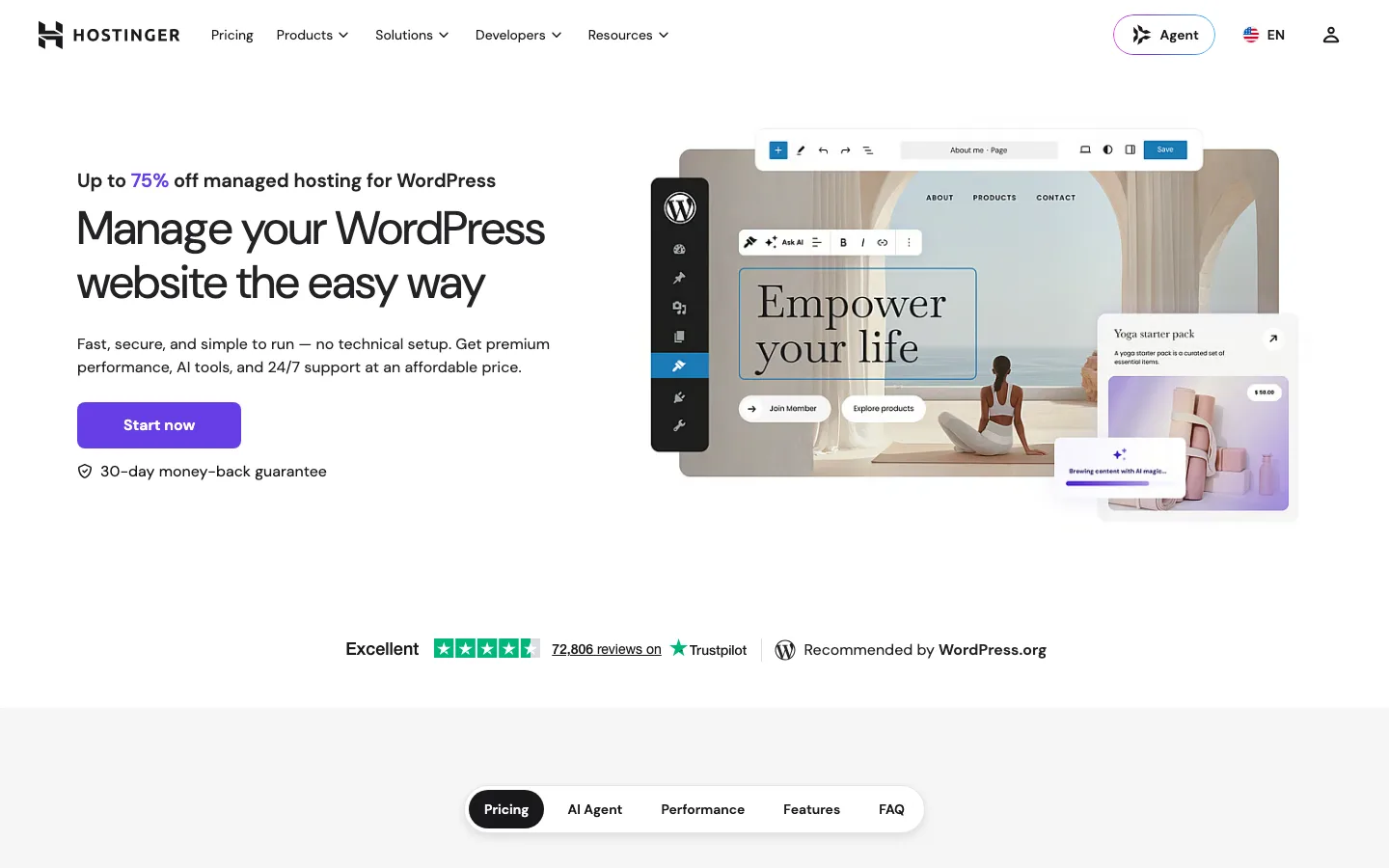
Hostinger’s managed WordPress hosting page.
Both hosts now sell their shared plans as managed WordPress hosting, and both are on WordPress.org’s list of recommended hosts.
Both hosts automate WordPress installation and updates and provide SSH and WP-CLI. Hostinger offers one-click installation or an AI builder and manages core, theme and plugin updates. Bluehost pre-installs WordPress, includes AI site tools and sends notice before managed updates.
Hostinger uses LiteSpeed Cache and object caching, with its CDN and hPanel staging from Unlimited. Bluehost manages page and Redis object caching through its plugin or Portal, enables Cloudflare from the Portal and includes plugin-based staging on all plans. Hostinger performs migrations free; Bluehost offers a free self-service tool or a $149.99-per-site assisted migration.
Hostinger’s edge is its stack. LiteSpeed servers paired with the LiteSpeed Cache plugin are a well-tested combination for WordPress, and the AI tools (Hostinger Agent, an AI troubleshooter and an optimizer) can do a lot of routine work for you. Our Hostinger review covers these in more detail.
Bluehost’s edge is that staging and a CDN come on every plan, including Starter. The Bluehost plugin puts caching settings and staging inside your WordPress dashboard, so you rarely need to leave it.
If you are on Hostinger Premium and want a test copy of your site, a staging plugin does the job. See our roundup of the best WordPress staging plugins.
Control panel: hPanel vs the Bluehost Portal
Hostinger uses hPanel, its own control panel, and does not offer cPanel on its current web hosting plans. hPanel has big labeled sections for websites, domains, email and files, plus an “Ask AI” assistant on every page. It is easy for first-timers; cPanel users need a little time to find things.
Bluehost uses the Bluehost Portal (its status page still calls it the Account Manager). Most day-to-day tasks are in the Portal: sites, backups, caching, Cloudflare, renewals. On shared and WordPress plans, you can also open cPanel from the Portal, so cPanel users can work the way they are used to. Bluehost’s Cloud (agency) plans do not include cPanel.
If you have never used hosting before, both are fine. If you want cPanel specifically, choose Bluehost, or look at FastComet, which also uses cPanel.
Data center locations
Both hosts have locations in the Americas, Europe and India. Hostinger lists Phoenix, Boston and Asheville in the US, Brazil, France, Germany, Lithuania, the Netherlands, the UK, India, Indonesia and Malaysia. It has no Oceania hosting location in this comparison, though it has a Sydney CDN edge.
Bluehost lists Arizona and Virginia, Toronto, São Paulo, Paris, Frankfurt, Madrid, London, Mumbai and Sydney. That gives Bluehost an Australian hosting option as well as Canadian and Spanish locations absent from Hostinger’s list here.
Hostinger’s list comes from its server locations help page. Bluehost’s comes from its sign-up guide, updated July 25, 2026. With both hosts, you pick a location when you set up the plan. Hostinger lets you move an active web or cloud plan to another location later from hPanel.
Bluehost added new locations for managed VPS and dedicated servers on September 9, 2026. Those do not apply to shared or WordPress plans.
Speed, uptime and status pages
Uptime guarantees, read closely
Both guarantees pay the same small credit, but the details differ.
- Hostinger promises 99.9% uptime per month. If it misses, you can ask for a credit of 5% of that month’s hosting fee, usable only on future Hostinger purchases. Hostinger decides whether the guarantee was missed.
- Bluehost promises 99.99% uptime on shared hosting, measured by the server’s operating system and Apache web server. If it misses, you can get at most one coupon per month for 5% of that month’s fee, however many outages there were. You must ask by phone or chat within 30 days. Scheduled maintenance, DDoS attacks and outages that only affect the Portal, FTP or email do not count. One FAQ answer on Bluehost’s WordPress page says 99.9%, while the plan cards and User Agreement say 99.99%.
With a 5% credit as the only remedy, neither guarantee is worth much money. Treat both as a statement of intent.
Status pages
Hostinger’s status page shows 90-day uptime per service. On October 4, 2026, its Core Services group showed 99.98% uptime over 90 days, and it listed a planned server migration running October 2 to 7.
Bluehost’s status page shows the current state of seven service groups: DNS and domains, email, hosting, Account Manager, Microsoft 365, Google Workspace, and voice and chat. All were “Operational” on October 4, 2026. We did not see uptime percentages on the page.
What we could and could not measure
Neither host lists a public demo site on its WordPress plans. We tried timing each host’s own marketing pages instead, from one location on October 4, 2026, and it did not give a fair result:
- Bluehost’s site answered automated requests with a Cloudflare security check (HTTP 403), so a speed test would time the check page, not Bluehost’s site.
- Hostinger’s marketing pages are served through Cloudflare’s network (and parts of the site through Google Cloud), not from its shared hosting plans. Their speed says nothing about how your site would run.
So we are not publishing speed numbers for either host, and you should ignore any comparison that times a host’s homepage. Independent reviewers who run test sites on both have published results this year: Cybernews monitored both for about two months and reported faster average response times on Hostinger, and HostAdvice also rated Hostinger ahead on speed and uptime. These are small test sites, so treat them as a rough guide.
Money-back guarantee
Hostinger’s 30-day window starts from the transaction, including a renewal, and does not exclude monthly hosting plans. Cryptocurrency payments are excluded, and a free domain’s price may be deducted.
Bluehost’s 30-day window applies only to the first term, excludes monthly plans and only covers credit-card payments. Its help center lists a $15.99 domain deduction. These restrictions make the two advertised guarantees materially different.
Hostinger’s refund policy was last revised on October 2, 2026. It is the more generous of the two, mainly because a surprise renewal charge can still be refunded within 30 days. With Bluehost, an unwanted renewal is not refundable, which makes the 16-day opt-out deadline above more important.
Support
Hostinger support starts with Hostinger Agent, its AI assistant. If the AI cannot fix the problem, a human specialist can join the chat. You can also continue on WhatsApp or by email. There is no phone support. Priority support is listed on Unlimited and Cloud Startup, not Premium.
Bluehost offers 24/7 chat on every plan. Phone support is included on Business and higher, and “not included” on Starter. Its marketing says experts are available on chat and phone around the clock. One Bluehost help article lists phone hours as 7 a.m. to midnight Eastern, seven days a week, so check before you rely on late-night calls.
On Trustpilot, as shown on each host’s own site in October 2026, Hostinger has a 4.6 rating from about 72,800 reviews and Bluehost has 4.5 from about 31,800 reviews.
Security and backups
Both include free SSL, a web application firewall, malware scanning and DDoS protection on every plan. Differences:
- Malware removal. Hostinger includes automatic malware removal on all plans. Bluehost Starter includes scanning but not removal. Removal starts on Business.
- Backups. Hostinger Premium backs up weekly. Unlimited backs up daily and keeps daily backups for 7 days and weekly backups for 7 weeks. Cloud Startup adds on-demand backups. Bluehost’s WordPress plans all list weekly backups. Its Basic Weekly Backup keeps a single restore point that each new backup overwrites, and it does not include email.
If you are on Hostinger Premium or any Bluehost plan, add your own backup plugin; the free version of UpdraftPlus is enough for most small sites. Our backup plugin roundup can help you choose.
WooCommerce
Both install WooCommerce for you.
Hostinger includes WooCommerce on every plan. For a real store, Unlimited ($3.99/mo intro, $16.99 renewal) is the minimum worth considering because of daily backups and the CDN. Cloud Startup is the better fit once orders pick up.
Bluehost sells dedicated eCommerce plans. eCommerce Essentials ($14.99/mo intro, $21.99 renewal) adds a bundle of premium commerce plugins for subscriptions, memberships, paid courses and an affiliate program. eCommerce Premium ($21.99/mo, $30.99 renewal) adds bookings, gift cards, rewards and more. In October 2026, Bluehost’s WooCommerce page also advertised limited-time Amazon gift cards with these plans.
If you need those extras, Bluehost’s bundle may cost less than buying the plugins one by one. If you just need a solid store, Hostinger gives you more for less and backs up daily.
Ownership and recent changes
Hostinger was founded in 2004 in Kaunas, Lithuania, and is still an independent company. It says it serves customers in more than 150 countries.
Bluehost is a brand of Newfold Digital, which also owns Network Solutions and other hosting brands. Newfold has folded some older brands into others over the years, as our A Small Orange review explains.
Notable changes in 2025 and 2026:
- Bluehost updated its User Agreement on July 22, 2026 to add AI service terms, and again on August 19, 2026 to add AI Credits, which some AI features now require. It now sells an “AI All Access” bundle for $20/mo. AI products are excluded from the money-back guarantee.
- Hostinger replaced its Kodee chatbot with Hostinger Agent, renamed its middle plan from Business to Unlimited, and revised its terms of service on September 29, 2026 and its refund policy on October 2, 2026. Its pricing page now marks CDN, AI tools and priority support as not included on Premium.
Moving between them
Hostinger’s team moves a Bluehost site for free. Going the other way, Bluehost’s self-service tool is free and its done-for-you service is $149.99 per site. To do it yourself in either direction, our All-in-One WP Migration guide walks through a full move. Cancel the old plan only after the new site works, and check its renewal date first.
Alternatives
- FastComet includes daily backups and a CDN on every plan and uses cPanel.
- DreamHost or GoDaddy are the other big budget names. Our DreamHost vs GoDaddy comparison weighs them, and if you are leaving GoDaddy, see our best GoDaddy alternatives.
- Managed WordPress hosts cost more but handle more for you. See our list of the best managed WordPress hosting.
For more options, see our best Bluehost alternatives, or browse all our WordPress hosting reviews.