Hostinger Review 2026: Is It Good for WordPress Hosting?
Hostinger is a good budget choice for a small WordPress site if you can prepay for a long term. Its easy control panel helps beginners, but renewals cost much more than the introductory deal. Look elsewhere if affordable monthly billing or quick phone support is essential.
Plans and real pricing
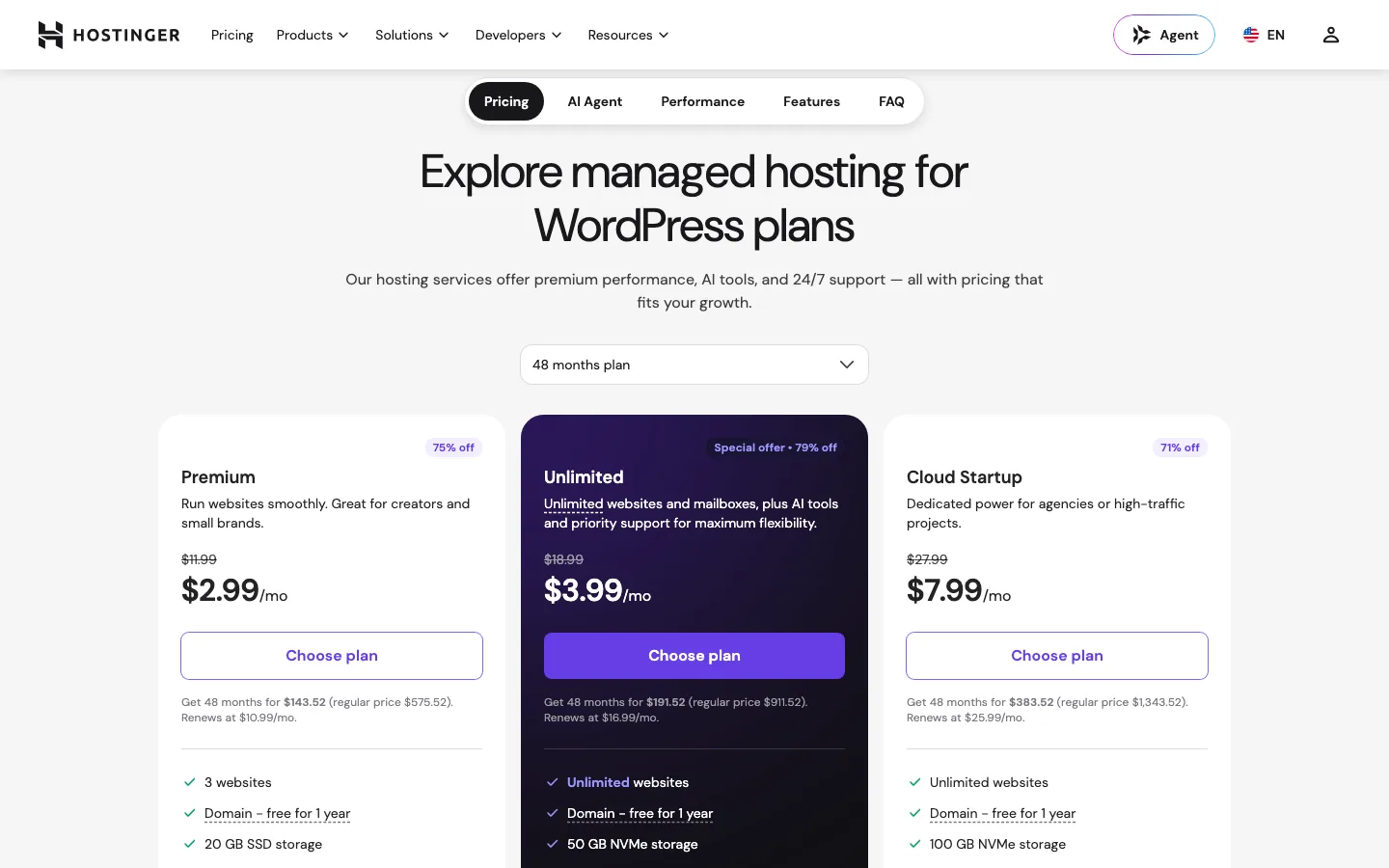
Hostinger’s WordPress plans on the 48-month term. Note the renewal price under each plan.
Hostinger’s WordPress plans and its regular web hosting plans are now the same three plans. The old Single plan is no longer on the WordPress pricing page. The middle plan is called Unlimited on the pricing page. Some of Hostinger’s help pages still call it Business, which was its name until recently.
All prices below are as of October 2026, in US dollars, before tax. Hostinger bills the whole term upfront.
Premium costs $143.52 for 48 months, equivalent to $2.99 monthly. Shorter commitments cost $83.76 for 24 months at $3.49, $47.88 for 12 months at $3.99, or $11.99 month to month. Renewal is $10.99 monthly.
Unlimited costs $191.52 for 48 months at $3.99, $107.76 for 24 months at $4.49, or $59.88 for 12 months at $4.99. Monthly billing costs $18.99 and renewal $16.99.
Cloud Startup costs $383.52 for 48 months at $7.99, $215.76 for 24 months at $8.99, or $119.88 for 12 months at $9.99. Monthly billing costs $27.99 and renewal $25.99.
What each plan includes:
Premium supports three websites with 20 GB SSD, weekly backups, one CPU core, 2 GB RAM, 40 PHP workers and 400,000 files. It includes two mailboxes per site free for a year, but no staging, CDN, priority support or dedicated IP.
Unlimited removes the site cap and adds 50 GB NVMe, daily backups, two cores, 3 GB RAM, 60 workers and 600,000 files. It includes staging, CDN, priority support and unlimited mailboxes free for a year. Cloud Startup raises storage to 100 GB NVMe, resources to four cores and 4 GB RAM, workers to 100 and files to two million, adding on-demand backups and a dedicated IP.
All three include a first-year domain on terms of at least 12 months. The free email period is also one year, rather than permanent inclusion.
“Unlimited” websites and bandwidth fall under Hostinger’s fair usage policy. In practice, the CPU, RAM, and inode limits above are what cap you.
What renewal really costs
This is the part most reviews rush past, so here is the math.
On Premium, the 48-month deal costs $143.52. When it ends, the same plan renews at $10.99 a month, which is $131.88 per year on an annual term. So your yearly bill goes from about $36 to about $132. That is roughly 3.7 times more.
The 12-month deal looks almost as cheap at first, but it ends sooner. If you buy 12 months of Premium and then renew for three more years at $10.99, four years costs about $444. The 48-month plan covers the same four years for $143.52. If you are sure you will keep the site, the long term saves a lot. If you are not sure, the 30-day refund window is short, and you are paying for years upfront.
Two more costs show up after year one:
- Email. The included mailboxes are free for the first year only. After that, Hostinger lists them at $0.59 per mailbox per month on a 12-month term.
- Domain. The free domain is free for one year. It then renews at the normal price for that extension.
Monthly billing exists, but it costs $11.99 for Premium with no discount and no free domain. That is a dollar more than the $10.99 renewal price, so it only makes sense for a short test.
Money-back guarantee
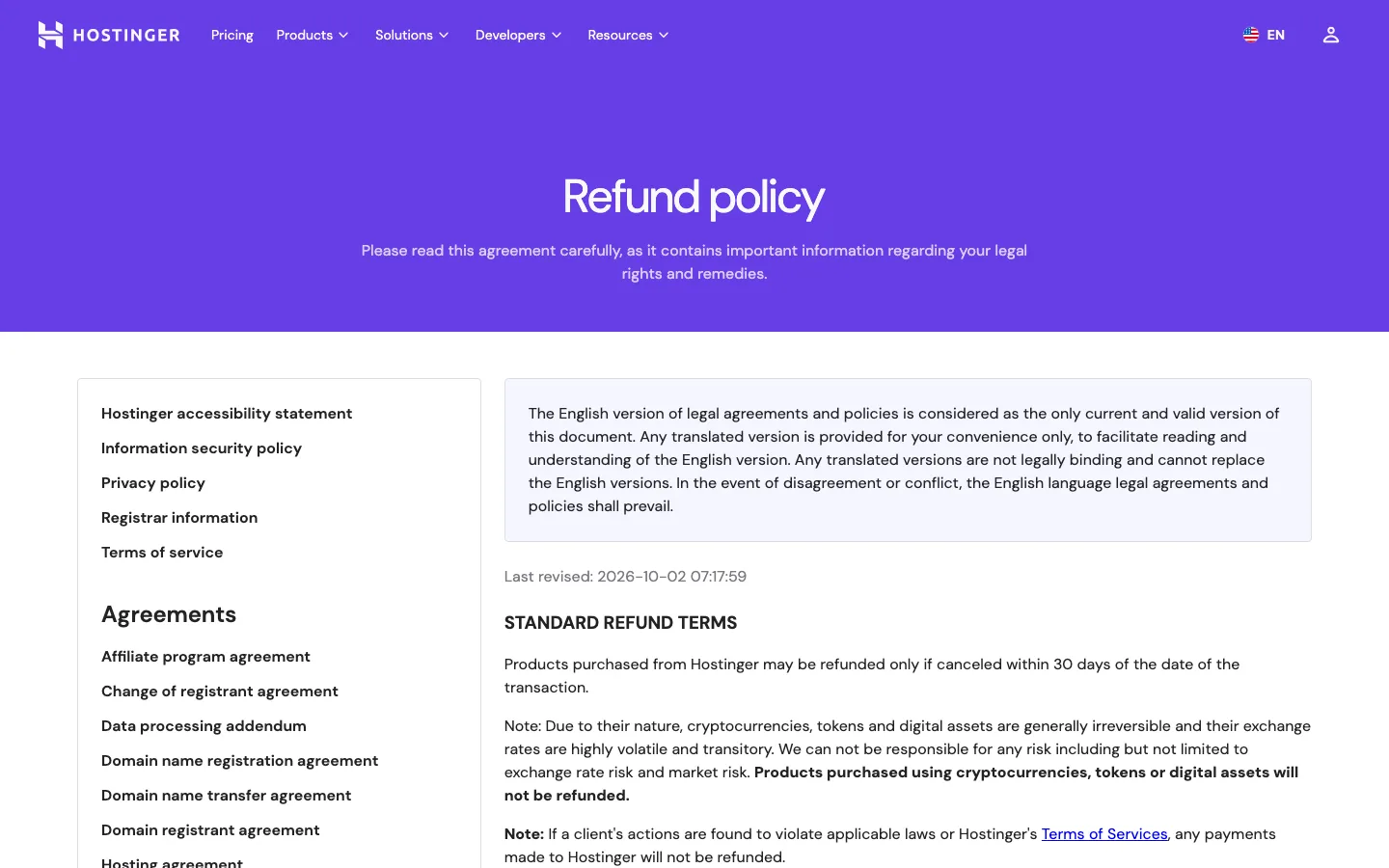
Hostinger’s refund policy, last revised.
Hostinger still refunds hosting cancelled within 30 days of the purchase. Its refund policy counts a renewal as a new purchase date, so if a renewal charge surprises you, you have 30 days to cancel and get it back.
Some things are not refundable:
- Domain renewals and completed domain transfers.
- The free domain that came with your plan. Hostinger may subtract the domain’s price from your refund, and you keep the domain for its term.
- Newly registered paid domains, unless you cancel within 96 hours.
- Anything paid for with cryptocurrency.
While the average beginner has nothing to worry about here, it is worth turning off auto-renewal in hPanel if you are not sure you will stay.
WordPress features
Hostinger includes WordPress installation, automatic updates, LiteSpeed caching and free migrations. Unlimited and higher plans add staging and a CDN; Premium does not include those in the checked plan details. Developers also get SSH, WP-CLI, Git, SFTP and PHP controls.
The AI tools include setup assistance, troubleshooting and an agent that can perform hosting tasks after confirmation. Some functions extend into WordPress on higher plans. Premium has a limited builder allowance rather than the complete AI package. Treat advertised automatic-fix rates as vendor claims, not a guarantee that support will solve every plugin problem.
Migration requests go through hPanel. If you prefer to move a site yourself, our migration guide covers copying, testing and switching DNS. For a store, see WooCommerce vs Shopify.
Performance and uptime
Hostinger uses LiteSpeed web servers, which handle WordPress traffic efficiently and pair with the free LiteSpeed Cache plugin. The Unlimited and Cloud Startup plans use NVMe storage, which is faster than standard SSDs. Note that the entry Premium plan is listed with plain SSD storage, not NVMe.
Hostinger guarantees 99.9% uptime. Hostinger advertises a speed boost of up to 40% from its caching, minification, and image optimization.
I have not run my own benchmarks for this review. Independent tests published this year are positive overall:
- Two separate tests measured largest contentful paint, the time until the main content appears, at about half a second on simple test pages. A third, on a heavier page, measured about 1.8 seconds.
- Shorter uptime checks, one of them nine days long, recorded 100% uptime.
- A longer six-week test recorded 99.93% uptime. That is above the guarantee, but it came with a few more short outages than some rivals in the same test.
- In one stress test with 250 simultaneous visitors, the server’s average response time stayed very low.
One honest caveat: these tests use small sites. On shared plans you share a server with other customers, so a busy WooCommerce store will feel the CPU and RAM limits sooner than a blog will. That is what Cloud Startup is for.
Data center locations
You pick a server location when you set up your plan, and you can move it later from hPanel. As of October 2026, web and cloud plans can use:
- North America: USA (Phoenix, Boston, and Asheville)
- South America: Brazil
- Europe: France, Germany, Lithuania, the Netherlands, and the United Kingdom
- Asia: India, Indonesia, and Malaysia
On Unlimited and higher plans, the CDN adds edge locations in places like Johannesburg, Japan, and Sydney, which helps if your visitors are far from those servers.
hPanel and ease of use
Unlike many hosts, Hostinger doesn’t use cPanel. It uses its own control panel, hPanel. It has an “Ask AI” button at the top of every page and is built around big, clearly labeled tiles for WordPress, domains, email, files, and databases.
If you have never used web hosting before, hPanel is easy to learn. Setting up a site is mostly a guided wizard. Independent reviews this year consistently rate it easy to use.
People coming from cPanel may need a day to find things. A few advanced options are in different places or have different names. Developers get SSH and Git, so you are not locked out of anything important.
Support
Hostinger’s support has changed more than anything else since 2020. Back then it was 24/7 live chat with real people and fast replies.
Now the first contact is Hostinger Agent, the AI assistant in your dashboard. You describe the problem, and it answers or runs through fixes. If it cannot solve the issue, a human Customer Success Specialist can join the chat. You can also continue the conversation on WhatsApp, or email support@hostinger.com. There is still no phone support.
Hostinger lists priority 24/7 support on Unlimited and Cloud Startup. On Premium, the pricing page shows priority support as not included.
How does it hold up? Hostinger’s Trustpilot page shows about 72,800 reviews with a 4.6 rating in October 2026. Most reviewers praise patient and helpful staff once they reach a person. The common complaints are about how hard it can be to get past the AI to a human, unexpected downtime, and renewal prices. Several independent reviewers this year said support is still good but not as quick to reach a human as it used to be. I think that is a fair summary.
The written help is still strong. Hostinger runs a large knowledge base, a tutorials section, and the Hostinger Academy YouTube channel with over 500 videos. Hostinger still has some of the best documentation in budget hosting.
Security and backups
Every plan includes:
- A web application firewall that blocks common attacks before they reach WordPress
- A malware scanner with automatic malware removal
- DDoS mitigation, with stronger DNS-level DDoS protection on Unlimited (Business) and Cloud plans
- Free SSL certificates for all your domains
- Automatic WordPress, theme, and plugin updates
Backups depend on the plan. Premium makes weekly backups only. If you post often or run a store, a week of lost changes is a real risk. Unlimited makes daily backups with easy restores, and Cloud Startup adds on-demand backups. On Premium, I would add a backup plugin such as UpdraftPlus, whose free version can send backups to Google Drive or Dropbox. Our backup plugin roundup can help you choose one.
One independent review this year noted that Hostinger’s shared servers are not PCI compliant. Most WooCommerce stores send card payments to Stripe or PayPal, so this rarely matters. It is worth knowing if you planned to handle card data on your own server.
Hostinger vs SiteGround
Searchers often weigh these two against each other. Here is how they compare as of October 2026:
Hostinger Premium and SiteGround StartUp both advertise $2.99 monthly, but Hostinger needs a 48-month prepayment and SiteGround 12 months. They renew at $10.99 and $17.99 respectively. Hostinger allows three sites and 20 GB storage with weekly backups; SiteGround allows one site and 10 GB with daily backups kept 30 days.
Hostinger includes two mailboxes per site free for a year and uses LiteSpeed, with an AI-first support flow. SiteGround includes email accounts and uses NGINX with its own caching, with 24/7 human support.
At the next tier up, SiteGround GrowBig starts at $4.99/mo and renews at $29.99/mo. Hostinger’s Unlimited plan renews at $16.99/mo.
Choose Hostinger if price matters most, you want to run a few sites on one plan, and you are fine with a long prepay.
Choose SiteGround if you want daily backups on the cheapest plan, quicker access to human support, and you can afford the much higher renewal. Our full Hostinger vs SiteGround comparison covers every plan and renewal term, and our Kinsta vs SiteGround and Cloudways vs SiteGround comparisons go deeper on SiteGround itself.
Hostinger alternatives
- SiteGround. Better support reputation and daily backups on every plan, but renewals cost a lot more. See above.
- Bluehost. Another budget host that WordPress.org recommends, popular with US beginners. Its pricing works the same way, with low intro prices and higher renewals. Our Hostinger vs Bluehost comparison lays out both hosts’ renewal prices term by term, and our Bluehost alternatives guide shows what switching costs over three years.
- Cloudways. Managed cloud hosting billed monthly, with no long prepay. It costs more per month but has no renewal jump. A good next step when a site outgrows shared hosting. Our Cloudways review breaks down the real monthly cost.
- FastComet. Another budget host we have reviewed.
- Premium managed hosts. If your site makes money and speed matters a lot, our list of the best managed WordPress hosting covers hosts like Kinsta and WP Engine, and our Kinsta review breaks down what Kinsta’s plans really cost.
If DreamHost or GoDaddy is also on your shortlist, our DreamHost vs GoDaddy comparison weighs the two, and our list of GoDaddy alternatives shows how Hostinger compares with other hosts on renewal prices.