6 Best Amazon WordPress Plugins in 2026 (After the PA-API Shutdown)
Our verdict: AAWP is still the best Amazon WordPress plugin for most affiliate sites. It already runs on Amazon’s new Creators API, it has the most polished product boxes and comparison tables, and it offers a paid fallback for sites that don’t yet qualify for Amazon’s API. AzonPress is the cheaper alternative at $39 a year. If you want a full Amazon-linked WooCommerce store, use WooZone. If you can’t spend anything yet, the free AffiliateX and ThirstyAffiliates plugins cover product boxes and link management without any Amazon keys.
Amazon has retired its old Product Advertising API (PA-API 5), and several long-standing Amazon plugins are gone or no longer worth buying. This guide covers what still works in October 2026, what it costs, and what each free plugin can do before you have API access.
Amazon WordPress Plugins: Quick Facts
Prices and versions were checked on each vendor’s site, CodeCanyon, or WordPress.org in October 2026.
| Plugin | Price (October 2026) | Free version | Amazon product data | Best for |
|---|---|---|---|---|
| AAWP | €79/year (1 site), or €299 one-time | No (30-day refund) | Creators API, or the paid AAWP API | Most Amazon review sites |
| AzonPress | $39/year (1 site), or $249 one-time | No | Creators API (since version 2.3.0) | Budget product boxes and tables |
| WooZone | $49 on CodeCanyon | No | Creators API (since version 15.1.0) | Amazon-linked WooCommerce stores |
| AffiliateX | Free; Pro from $69/year | Yes, 9,000+ installs | Pro only (Creators API or “Zero API”) | Free product boxes and tables |
| ThirstyAffiliates | Free; Pro from $249/year | Yes, 30,000+ installs | Pro only (Amazon importer) | Link cloaking and click tracking |
| Content Egg | Free; Pro from $59/year | Yes, 10,000+ installs | Pro only (Creators API, or “NoAPI” with a scraping service) | Price comparison across many stores |
What Changed: Amazon Replaced PA-API 5 With the Creators API
Every plugin that shows live Amazon prices, images, or ratings gets that data from Amazon’s API, which in 2020 meant PA-API 5. According to Amazon’s Associates documentation, PA-API 5 “has been deprecated and is being replaced by the Creators API,” and plugins that still call it now get a “403 Forbidden” error. An unmaintained Amazon plugin simply stops updating product data.
Here is what the switch means for you:
- New credentials. The Creators API uses a Credential ID and Credential Secret, made under Tools > Creators API in Associates Central. Amazon says old PA-API access keys will not work.
- A higher bar to get in. Amazon lists “at least 10 qualifying sales within the past 30 days” as a prerequisite, and only the primary owner of the Associates account can register. In 2020 the bar was three sales.
- Access can lapse. AAWP and AffiliateX both say in their docs that Amazon pauses Creators API access if you drop below 10 qualifying sales in a 30-day period, and restores it a couple of days after sales pick up.
- Plugin updates matter more than ever. Only buy a plugin whose developer has shipped Creators API support. All three paid picks below have.
Without those 10 sales, you can add products by hand with a free plugin, use text links from Amazon’s SiteStripe toolbar, or pay for a plugin’s own fallback data service.
How We Picked and Tested
We left out any plugin that was closed, pulled from sale, or unmaintained, and included AffiliateX and Content Egg, two of the most-installed Amazon-focused free plugins on WordPress.org that are still updated.
The three free plugins were installed on a test site (WordPress 7.1.2, PHP 8.3, the default Twenty Twenty-Five theme). We ran each setup screen, skipped every account sign-up, and used each plugin without Amazon API keys, since that is where most new affiliates start. AAWP, AzonPress, and WooZone are paid-only, so we did not buy them; those reviews are based on the vendors’ published details and official demos.
1. AAWP: Best Amazon Plugin Overall
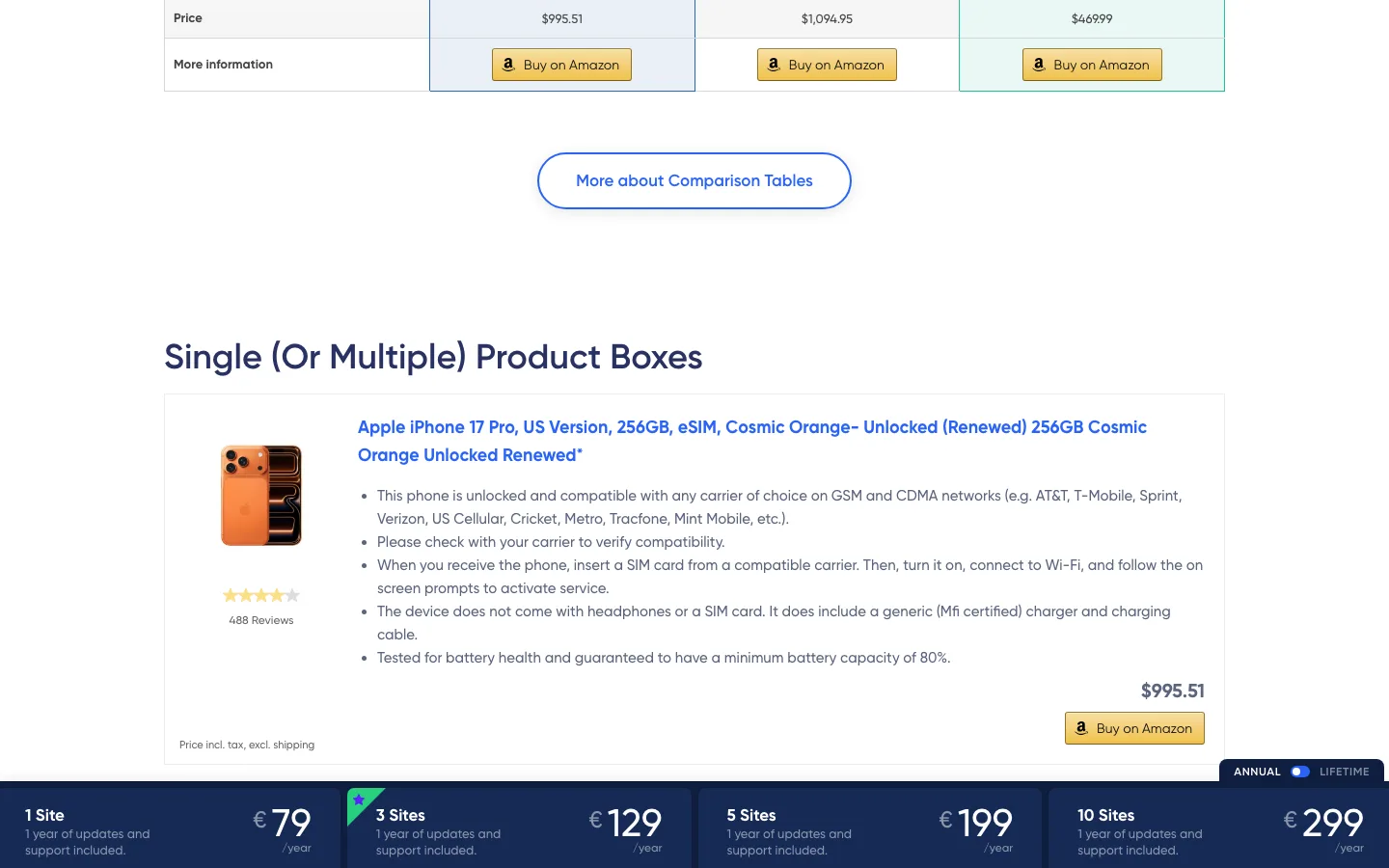
A product box on AAWP’s official demo page, with the current plan prices along the bottom, October 2026.
AAWP (Amazon Affiliate WordPress Plugin) is still the plugin most Amazon affiliates end up using. The vendor says it is installed on more than 100,000 WordPress sites. Our full AAWP review covers its pricing, updates and the AAWP API in more depth.
It builds product boxes, comparison tables, automatic bestseller and new release lists, and “data fields” that drop a single live value, like the current price, into a sentence.
AAWP’s docs walk through connecting the Creators API under AAWP > Settings > Amazon API. If you don’t meet Amazon’s 10-sale rule yet, or you lose access during a slow month, the paid AAWP API add-on supplies product titles, prices, images, and descriptions instead. AAWP says plans cover 150 to 1,000 products a month, and bestseller lists don’t work through it yet.
EasyAzon now lives here too. The old easyazon.com address redirects to AAWP’s site, and AAWP shows a popup saying “EasyAzon has been replaced by AAWP.”
Pricing (October 2026): €79/year for 1 site, €129 for 3 sites, €199 for 5 sites, €299 for 10 sites. Lifetime licenses start at €299 one-time for 1 site. AAWP offers a 30-day refund.
Pros: the most complete set of Amazon display options, already on the Creators API, and a paid fallback for sites without API access.
Cons: no free version, and the AAWP API costs extra.
2. AzonPress: Best Budget Alternative
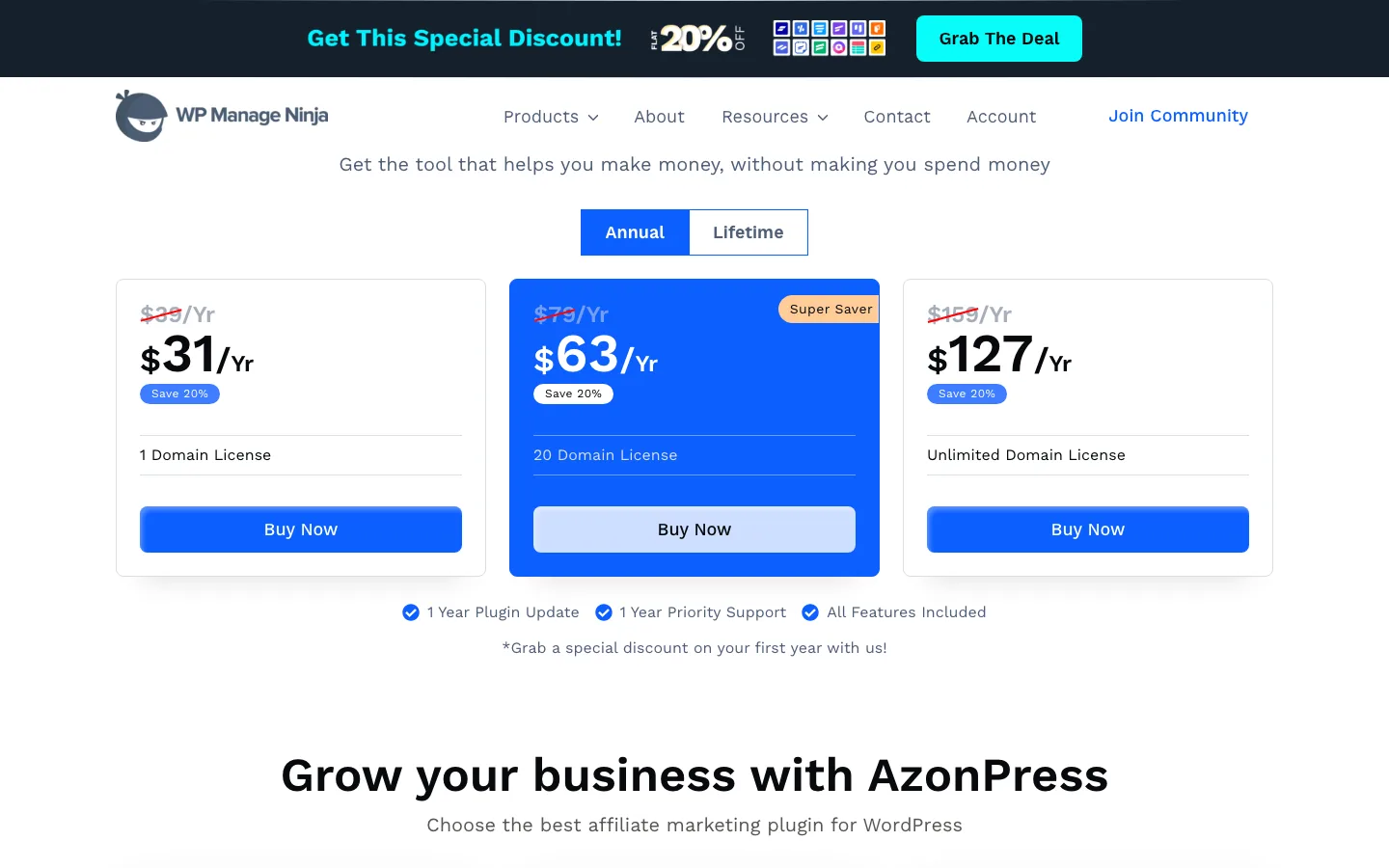
AzonPress annual plans on the WPManageNinja site, showing a first-year discount, October 2026.
AzonPress comes from WPManageNinja, the team behind Fluent Forms. It covers the same ground as AAWP for less money: single product boxes, product grids and lists, comparison tables, and Gutenberg blocks for adding them.
In version 2.3.0 (announced in July 2026), AzonPress made the Creators API its only Amazon data source and removed the PA-API settings. The release notes also list a few casualties of the switch: Prime badges, “lowest price,” and offer count are gone. Its “Zero API” feature lets you add custom products from Amazon, eBay, Etsy, or any other store by hand, so new affiliates can start before they qualify for the API.
Pricing (October 2026): $39/year for 1 domain, $79/year for 20 domains, $159/year for unlimited domains. Lifetime licenses cost $249, $399, and $599. When we checked, the site offered 20% off the first year ($31 for 1 domain).
Pros: about half the price of AAWP for one site, and a 20-domain plan that suits site portfolios.
Cons: lost Prime badges and lowest-price data in the API switch.
3. WooZone: Best for an Amazon WooCommerce Store
WooZone (also sold as WZone) takes a different approach. Instead of adding boxes to blog posts, it imports Amazon products into WooCommerce as real products. Visitors browse your store, and when they buy, they are sent to Amazon to check out, so you earn the affiliate commission. If you would rather run an auction site, see our list of WordPress auction themes and plugins.
WooZone is still actively maintained. On CodeCanyon it has 36,165 sales, a last update of August 3, 2026, and a listing that says it works with WooCommerce 9.x. Version 15.1.0 added Creators API support to its “No PA API Keys” module, which handles importing and syncing products. The vendor also notes that its old Chrome extension for importing without keys “will become unavailable soon.”
WooZone keeps prices and stock in sync with scheduled jobs, so expect some setup work.
Pricing (October 2026): $49 for a CodeCanyon Regular License (one site), with 6 months of support.
Pros: a full WooCommerce catalog of Amazon products, still updated in 2026, and a one-time price.
Cons: more moving parts than a box plugin, and big catalogs need decent hosting.
4. AffiliateX: Best Free Plugin for Product Boxes
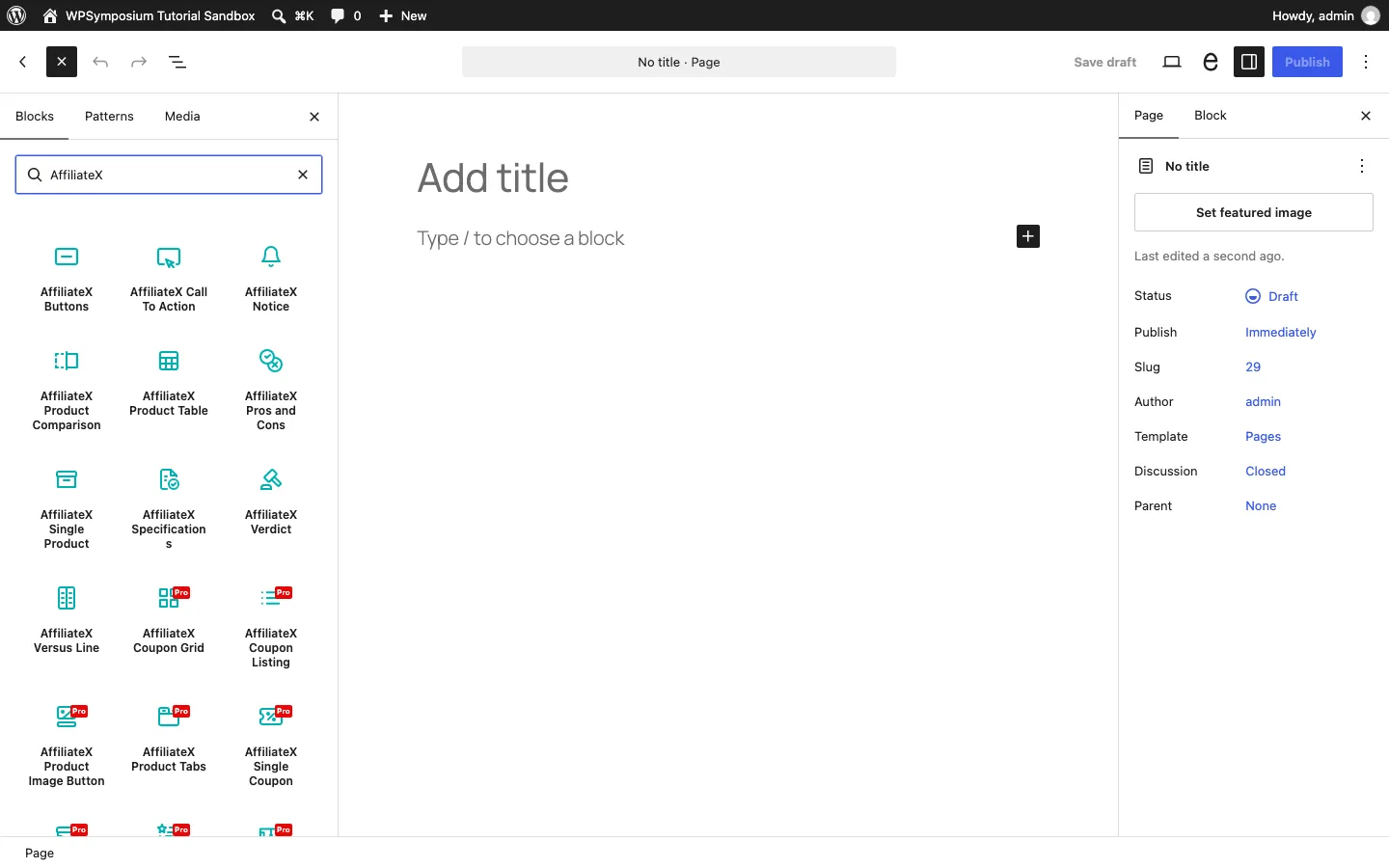
AffiliateX blocks in the block inserter on a fresh install, version 2.3.10, October 2026. Blocks with a red “Pro” tag need the paid version.
AffiliateX is a set of Gutenberg blocks for affiliate content. The free version on WordPress.org (version 2.3.10, updated September 20, 2026) has 9,000+ active installs and a 4.5 out of 5 rating.
What we saw on our test install:
- The first visit to the AffiliateX menu opens an opt-in screen asking to share site data and receive emails. “Skip” works, and the plugin runs fine without opting in.
- After install, two AffiliateX notices appeared at the top of every admin screen, including other plugins’ pages: an opt-in reminder and a “Summer Sale: 20% Off AffiliateX Pro” banner (still running in October). Both can be dismissed.
- The block inserter shows 20 AffiliateX blocks. 10 are free: Single Product, Product Table, Product Comparison, Pros and Cons, Verdict, Specifications, Notice, Call to Action, Buttons, and Versus Line. The other 10 (coupons, product tabs, top products, rating box, dynamic listing, and more) are Pro.
- The API Integration screen lists Amazon, eBay, and AliExpress, all locked to Pro.
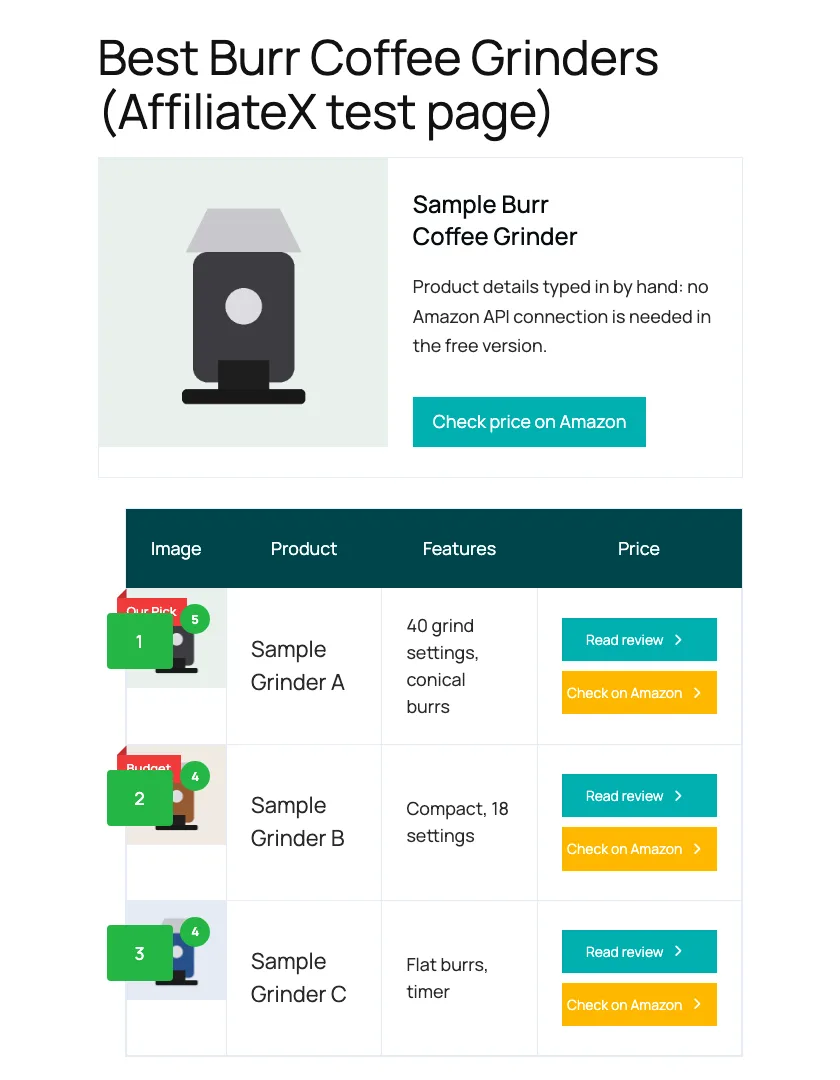
A Single Product box and Product Table from AffiliateX 2.3.10 on our test site, filled in by hand with sample products, October 2026.
We built a sample “best coffee grinders” page with a Single Product box and a three-row Product Table, typing the names, prices, and features in by hand and linking the buttons to an Amazon URL. It took a few minutes and needed no Amazon account. The button settings include separate nofollow and sponsored toggles, which is how Google asks sites to mark paid links.
Two rough edges: in Twenty Twenty-Five’s normal content width, the table’s rank number, ribbon, and rating badges overlapped the product images. And with WordPress debug output switched on, AffiliateX printed a PHP 8.3 “deprecated” notice at the top of the page. Most live sites hide debug output, but developers will see it.
The catch with any manual setup is that prices go stale. AffiliateX Pro adds Amazon API integration (its docs cover the Creators API) and a “Zero API” fallback for sites without API access.
Pricing (October 2026): Free. Pro costs $69/year for 1 site, $169/year for 3 sites, or $199 one-time for 1 site.
Pros: useful free blocks with no Amazon keys needed, plus free click analytics and a broken link checker.
Cons: upsell banners across the admin after install, and typed-in prices go out of date.
5. ThirstyAffiliates: Best for Managing Amazon Links
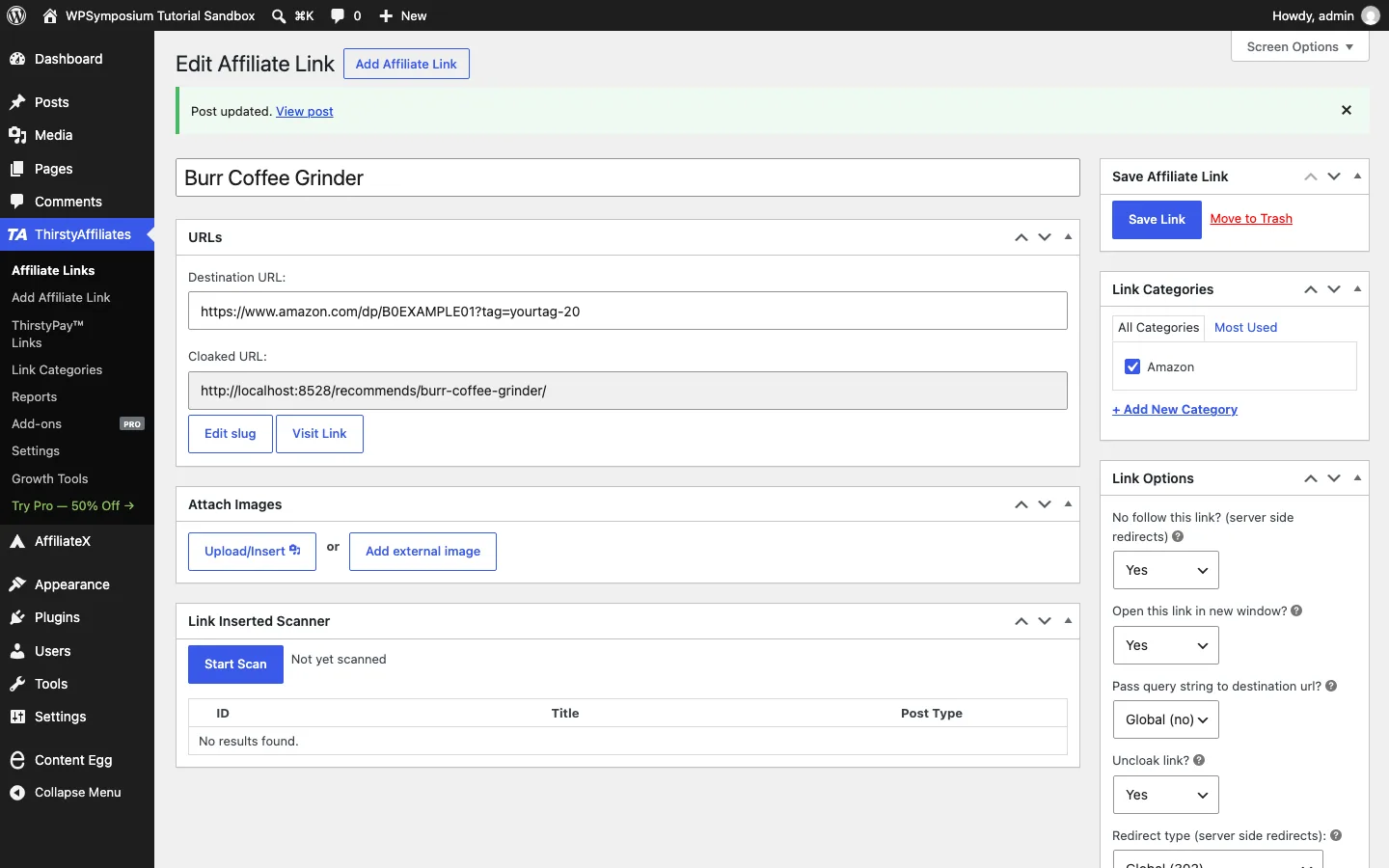
Editing an Amazon link in ThirstyAffiliates 3.12.0 on our test site, with nofollow, new window, and uncloak switched on, October 2026.
ThirstyAffiliates doesn’t build product boxes. It manages links. You store each affiliate URL once, give it a short local address like /recommends/product-name/, and change it in one place if Amazon or your tag changes. The free version (3.12.0, updated August 25, 2026) has 30,000+ active installs and a 4.6 out of 5 rating.
What we saw on our test install:
- There is no setup wizard. We added a link (title, Amazon destination URL, and a new “Amazon” category) and saved it in about two seconds.
- The short link worked straight away, sending visitors to Amazon with a 302 redirect.
- New links default to no nofollow and no new window, so set those yourself.
- Upsells are quieter than AffiliateX: a dismissible “You’re using ThirstyAffiliates Lite” bar, a “Try Pro” menu item, and a Pro Features tab in settings.
Cloaking matters for Amazon. ThirstyAffiliates’ own settings say uncloaking is “important for compatibility with some affiliate program with stricter terms (such as Amazon Associates).” The free version has an Uncloak Links module for this. We switched it on and set our Amazon link to uncloak. On the live page, the HTML still held the /recommends/ link, and the plugin’s Link Fixer script swapped in the real Amazon URL after the page loaded. Two quirks: the script rewrote the URL with http instead of https, and on an AffiliateX button it replaced the “nofollow sponsored” tags with plain “nofollow.” If you run both plugins, check your links after enabling uncloak.
Pro adds an Amazon importer that searches Amazon from inside WordPress, plus geographic redirects and CSV import. Its help docs still describe PA-API keys, so ask the vendor about Creators API support before you buy Pro for that feature.
Pricing (October 2026): Free. Pro Basic is normally $249/year for 1 site; the site showed $99.60 for the first year when we checked. Plus (5 sites) is $374/year and Pro (10 sites) is $499/year before discounts.
Pros: free, fast, no account needed, and an uncloak option built for Amazon’s rules.
Cons: no product boxes or prices, uncloaking depends on JavaScript, and Pro is expensive at full price.
6. Content Egg: Best for Price Comparison Sites
Disclosure: KeywordRush, the company behind Content Egg, gave us a free Content Egg Pro review license. That did not affect our verdict, and we point out the weak spots we found.
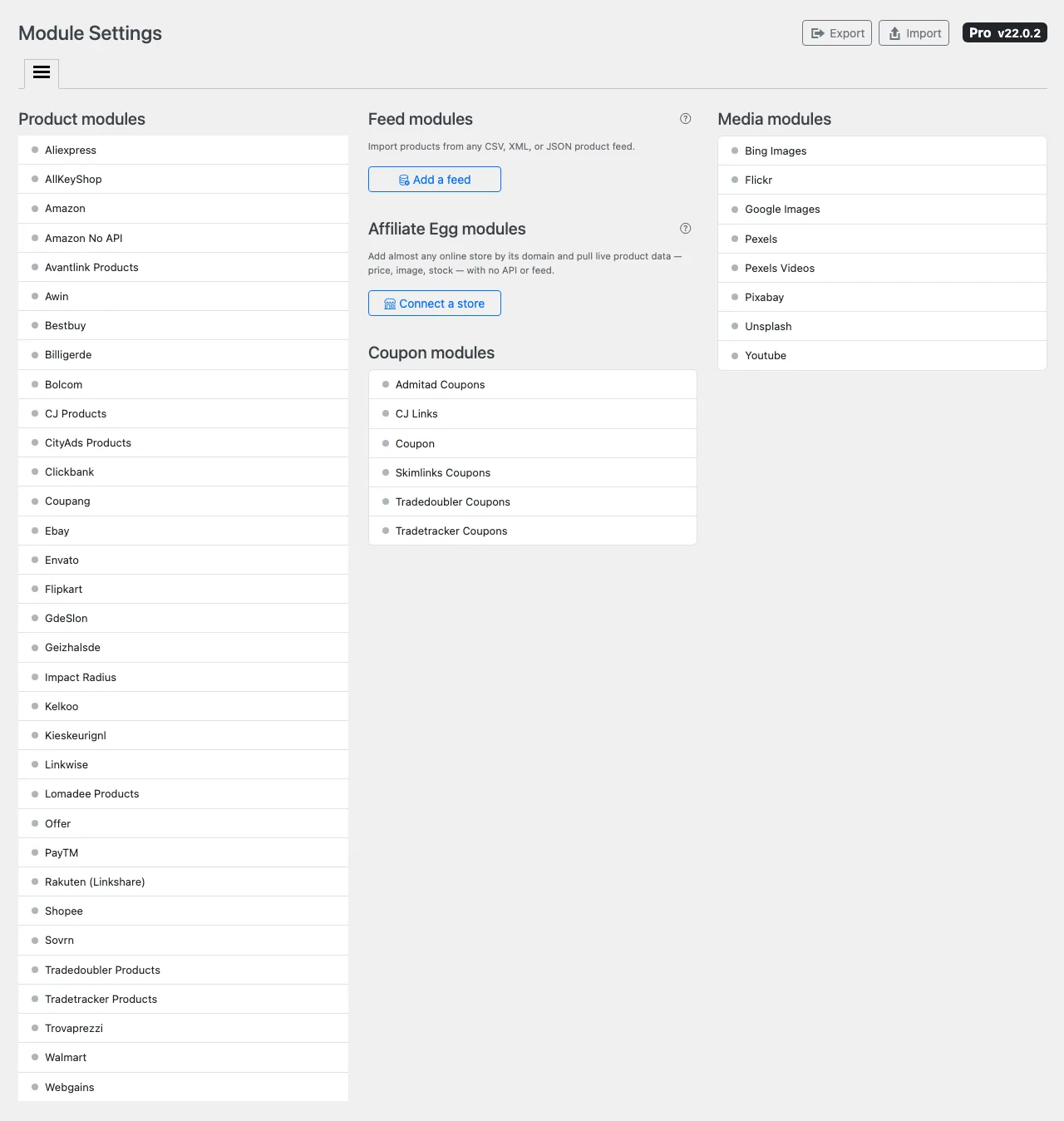
The Module Settings screen in Content Egg Pro 22.0.2 on our test site, with 33 product modules, October 2026.
Content Egg pulls products and prices from stores and affiliate networks, then shows them as product cards, price comparison lists, and price history charts. The free plugin (11.9.0, updated September 23, 2026) has 10,000+ active installs and a 3.9 out of 5 rating, but it has no Amazon module. So we installed Content Egg Pro 22.0.2 on a fresh WordPress 7.1.2 test site and tried everything we could without signing up for other services.
Setup: until you enter a license key, Pro shows only a License screen. After activation, the menu fills in with Settings, Modules, Import Tools, AI Agents, Prefill, Shops, Clicks Statistics, and more. Every module starts switched off. On our test install we counted 33 product modules (Amazon, Amazon No API, eBay, Walmart, AliExpress, Best Buy, Awin, CJ, Impact, Rakuten, and many regional stores), 6 coupon modules, 8 media modules, and a wizard for CSV, XML, or JSON product feeds.
Amazon has two modules, and neither worked without extra accounts.
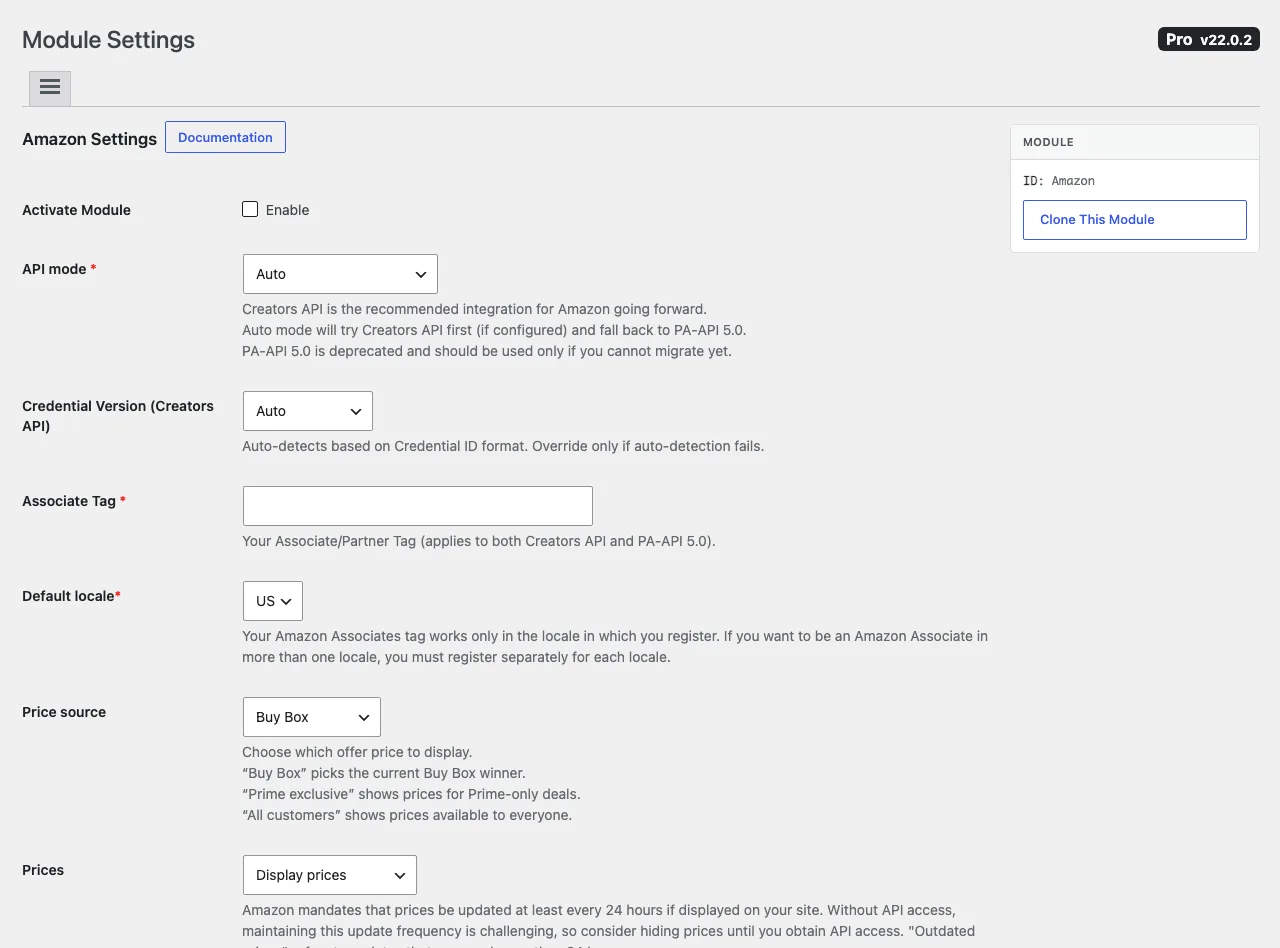
The Amazon module’s settings in Content Egg Pro 22.0.2. Creators API is the recommended mode and PA-API 5.0 is marked deprecated, October 2026.
The Amazon module runs on the Creators API and keeps PA-API 5.0 as a deprecated fallback. It asks for your Associate tag plus a Creators API Credential ID and Secret, which you only get once Amazon grants API access (see the sales rules in the FAQ below). We don’t have those keys, so we couldn’t test it.
The Amazon No API module needs only an Associate tag, because it reads product data from Amazon’s website instead of the API. On our test install, a keyword search returned: “It seems your server IP has been blocked by Amazon.” The message tells you to add one of six built-in scraping services (ScraperAPI, Scrapingdog, ScrapeOwl, Decodo, Crawlbase, or Bright Data). Each is a separate account with its own plans. The error also printed its help link as raw HTML code. By default, NoAPI hides prices older than 24 hours and has price updates switched off, since Amazon requires displayed prices to be refreshed daily.
Two other routes need more than the license: “Connect a store”, which pulls products from almost any shop’s website, needs the separate Affiliate Egg plugin, and eBay needs eBay developer keys plus an eBay Partner Network campaign ID.
Adding products to a post: in the block editor, an “e” button opens a Manage products window. You search by keyword, product URL, or EAN across all active modules at once and click Add. Products save to the post straight away, and you can sort them into groups. A Shortcode tab builds shortcodes from 22 display templates. The block inserter adds 26 “Egg Blocks” (product card, comparison table, pros and cons, verdict, FAQ, and more) and four general product blocks. The Comparison Table block filled in titles, images, and buttons from the products we picked, but showed no prices until we added comparison rows ourselves.
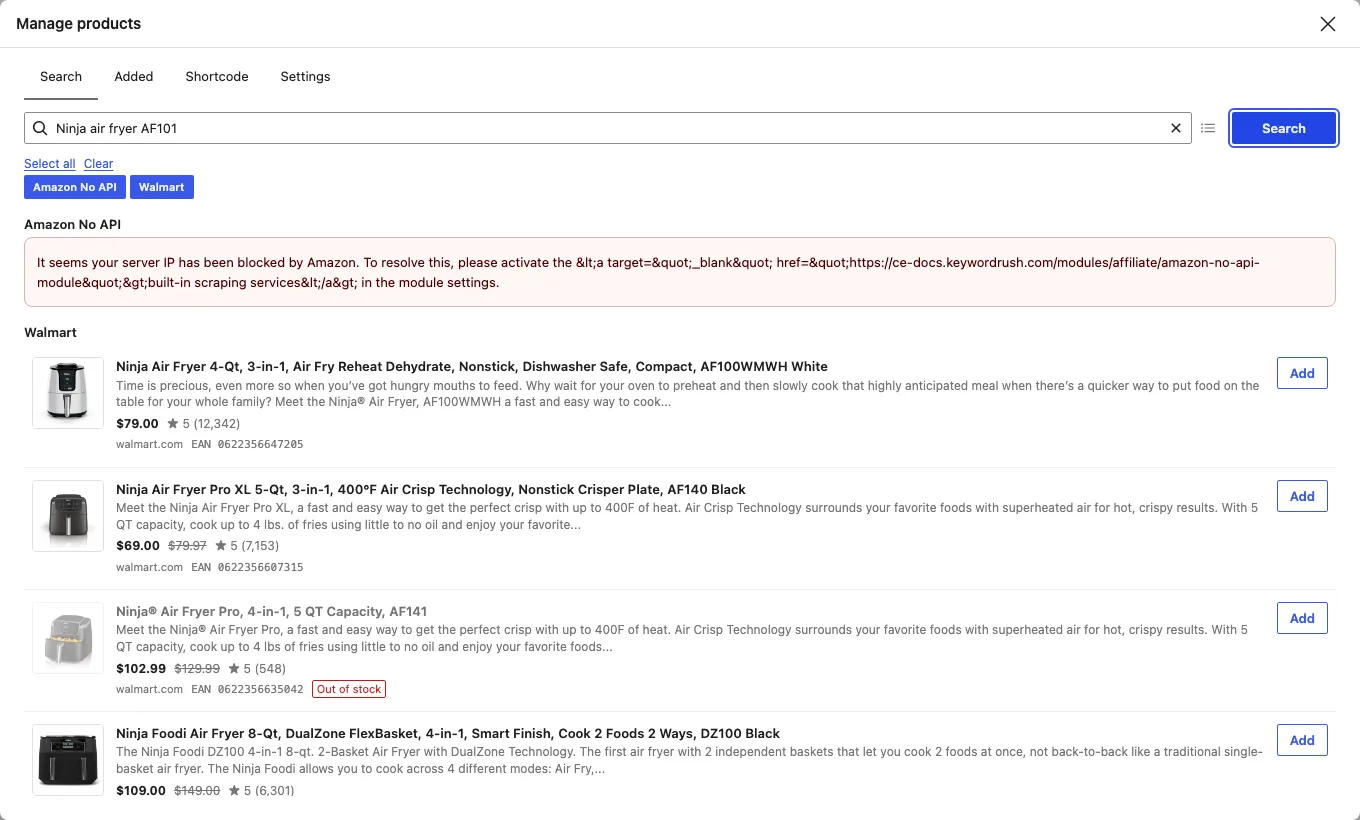
One search across Amazon No API and Walmart from the post editor. Amazon returned the “IP blocked” error, Walmart returned live products, October 2026.
Price comparison and price history: Walmart was the one store that worked with no keys. The module uses KeywordRush’s own Walmart API access and only asks for your Impact publisher ID so you get paid. We added the Ninja AF141 air fryer from Walmart, typed in a second offer from SharkNinja’s store by hand, put both in one group, and added the comparison templates.
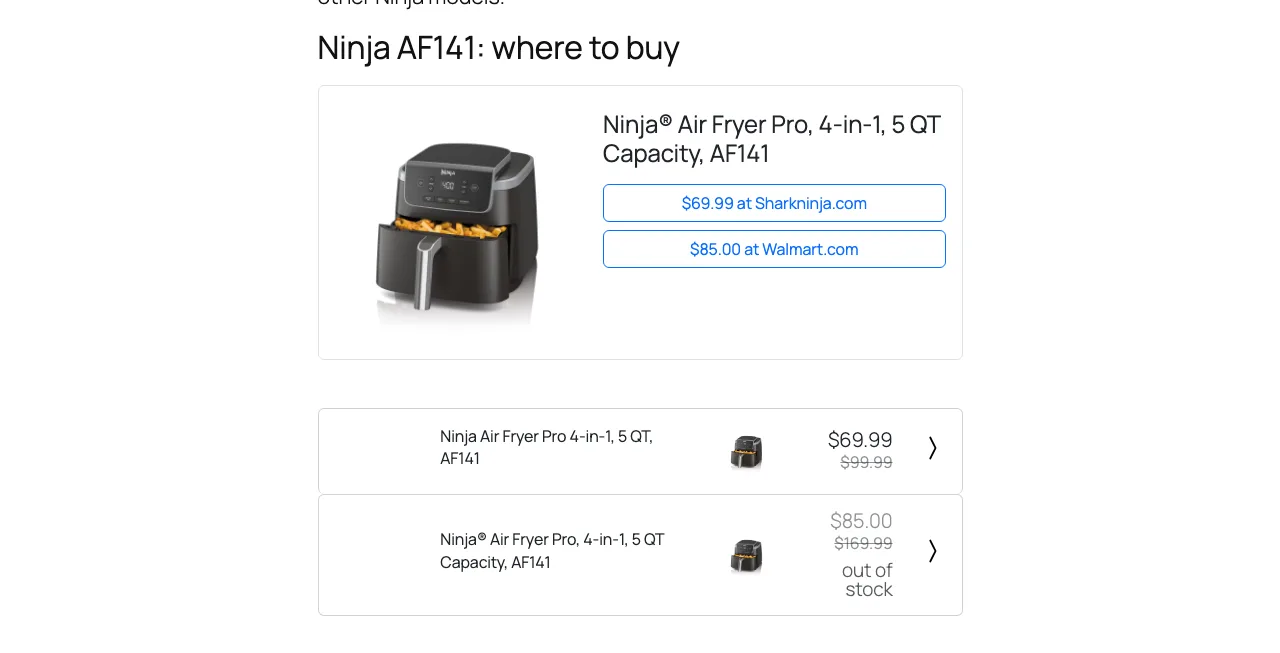
Content Egg’s price comparison card and store list for one air fryer: a hand-entered SharkNinja offer and a live Walmart offer, October 2026.
The cheaper offer came first. The store list marked Walmart’s offer “out of stock”, but the card above it showed the same offer as a normal “$85.00 at Walmart.com” button.
Prices refresh through WP-Cron. Walmart’s default is every three days; we shortened it to one minute and ran the cron, and three Walmart prices changed (one went from $79.00 to $59.00).
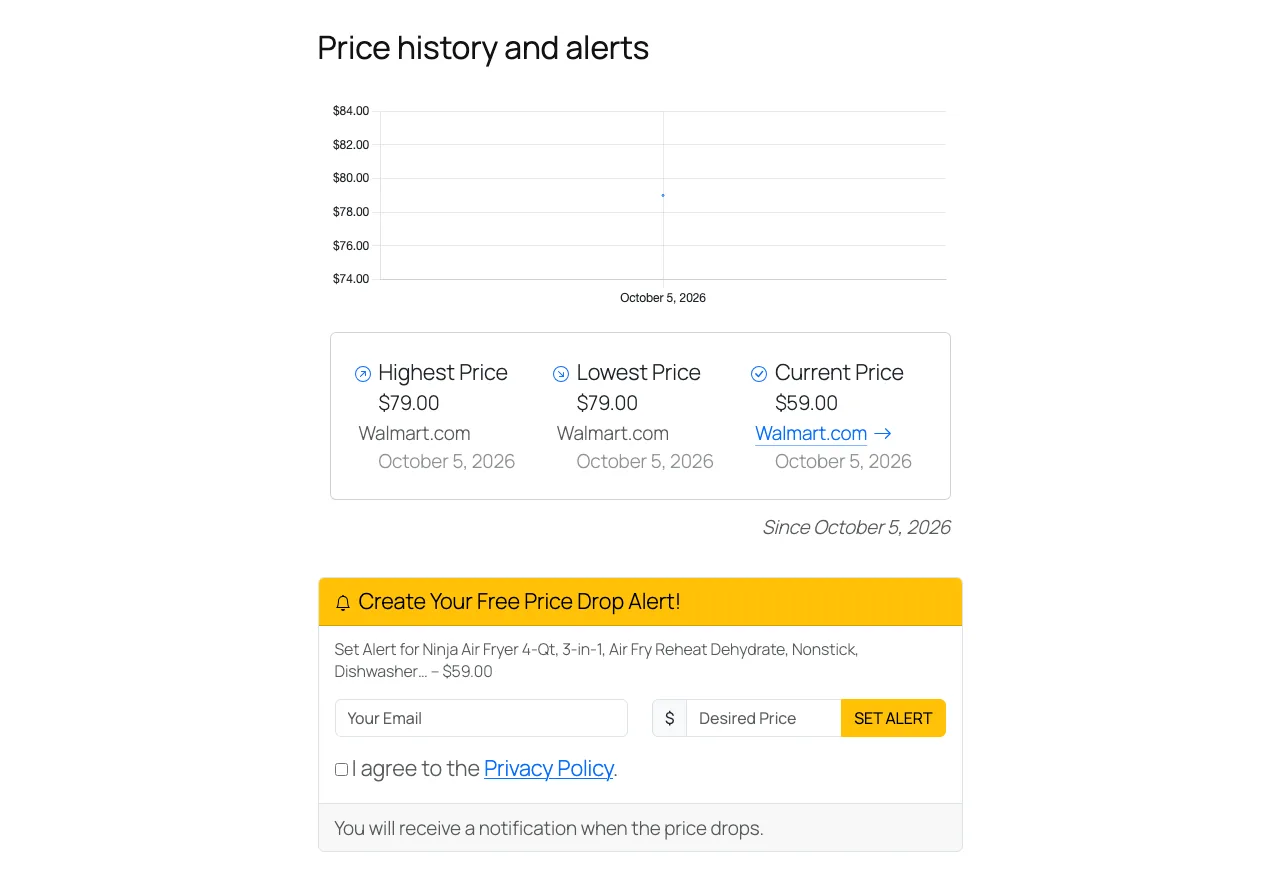
Price history and price drop alert for a Walmart product after one price update, October 2026.
Price history keeps one point per day, so a one-day test shows a single dot. Its summary box still listed the lowest price as $79.00 while the current price was $59.00. Content Egg’s own docs advise against price history for Amazon products, because Amazon’s rules don’t allow it. The price drop alert form worked: we subscribed with a test address and got “Please verify your email address”, so alerts are double opt-in. Our test site sends no email, so we didn’t see the message itself.
Import tools and AI: Import Tools turn products into posts in bulk. Our first import with the “Simple post” preset failed with “OpenAI integration is not enabled”, because the preset has AI options ticked by default. After we cleared them, two Walmart products became posts. The AI presets, the Prefill tool, and AI text need your own OpenAI, OpenRouter, or Claude API key. The older Autoblogging page says the feature “is now deprecated” and points to Auto Import. We didn’t test WooCommerce sync.
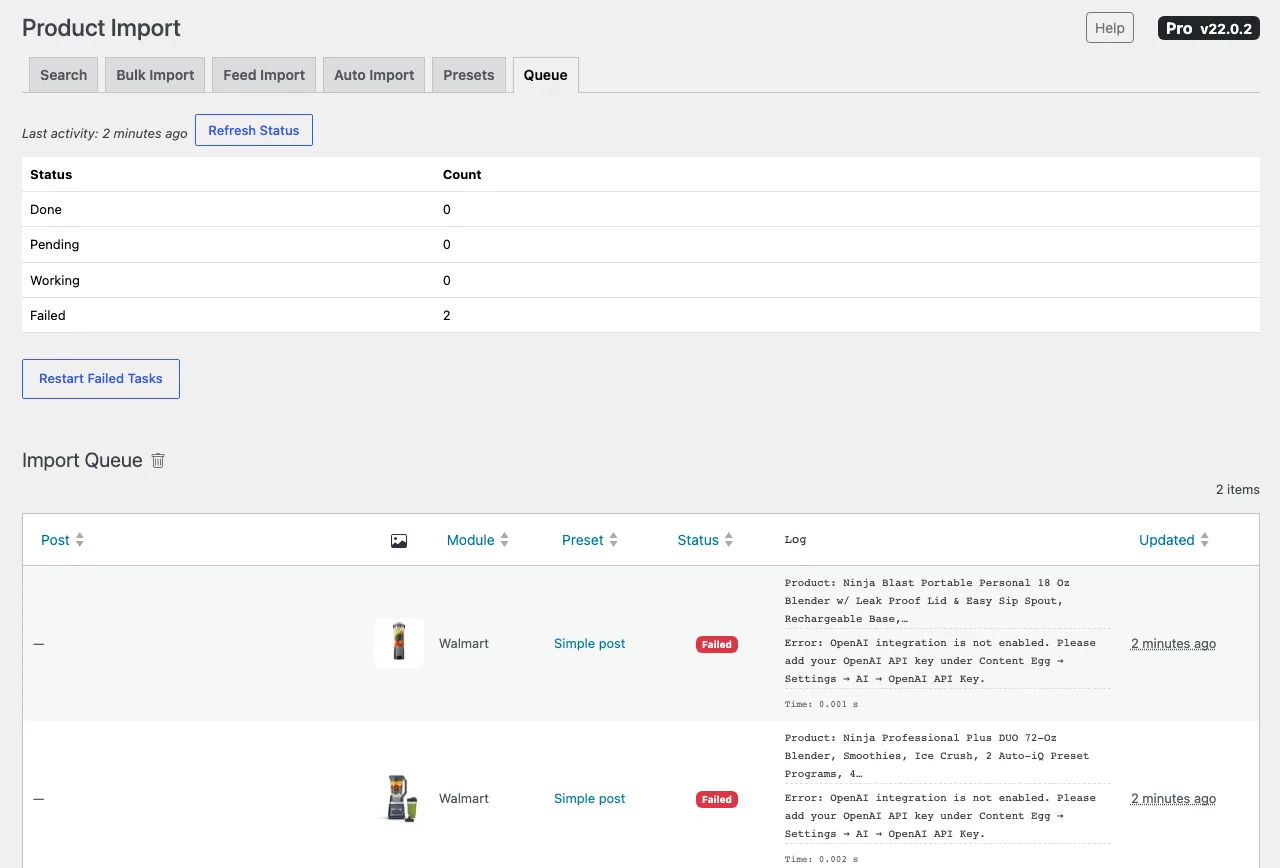
The import queue after our first try with the “Simple post” preset, October 2026.
Performance: a post with one product card loaded two Content Egg stylesheets, about 223 KB before compression, mostly a 217 KB Bootstrap file. Adding the price history chart raised that to about 479 KB with Chart.js. Posts without Content Egg products loaded nothing from the plugin.
Pricing (October 2026): Free. Pro costs $59/year or $149 one-time for 1 site, $99/year or $249 one-time for 5 sites, and $179/year or $449 one-time for 25 sites. Every plan has the same features. If a yearly plan lapses, the plugin keeps working, but updates and support stop.
Who it suits: sites that compare several stores, especially Walmart and stores on networks like Awin, CJ, or Impact. If Amazon is your only store and you don’t have API access yet, AAWP or AzonPress with their paid fallback services are simpler.
Pros: many stores in one plugin, a Walmart module that works without an API key, price history, double opt-in price alerts, and a large set of blocks.
Cons: Amazon needs Creators API access or a separate scraping service, the Bootstrap stylesheet is heavy, and the AI import features need your own paid API key.
How to Choose an Amazon WordPress Plugin
Start with your Amazon account status, not the feature list.
- No API access yet (under 10 sales in 30 days). Use AffiliateX free for boxes and tables and ThirstyAffiliates free for links. Leave prices out, or update them by hand.
- You qualify for the Creators API. Pick AAWP for the most display options (see our AAWP review for whether it is worth €79 a year), or AzonPress to save money or cover many domains. Both refresh prices and images automatically.
- Your sales go up and down. Look at the paid fallbacks (AAWP API, AffiliateX Zero API, AzonPress Zero API) so boxes keep working if Amazon pauses your access.
- You want a store, not a blog. Use WooZone.
- You compare several retailers. Use Content Egg Pro. Walmart works without keys, but Amazon still needs Creators API access or a scraping service.
Whatever you choose, check when the plugin was last updated. An Amazon plugin that hasn’t shipped Creators API support is now broken by design. Product boxes also add images and scripts to your pages, so pair them with a lightweight theme; our fastest WordPress theme benchmark is a good place to start. For product review schema and other on-page basics, see our guide to the best SEO plugin for WordPress.
FAQ
Do Amazon WordPress plugins still work after PA-API 5 was retired?
Only the ones that were updated. Amazon says calls to PA-API 5 now return a “403 Forbidden” error. AAWP, AzonPress (from version 2.3.0), WooZone (from version 15.1.0), AffiliateX Pro, and Content Egg Pro support the Creators API, according to their vendors. You also need new Creators API credentials, because old PA-API keys don’t carry over.
Can I use an Amazon plugin without API access?
Yes. On our test install, AffiliateX’s free blocks and ThirstyAffiliates’ free link manager both worked with no Amazon keys; you type product details in by hand. Several paid plugins also sell their own data services for this case: AAWP API, AffiliateX Zero API, and AzonPress Zero API. Content Egg Pro’s NoAPI module is different: on our test install it returned an “IP blocked” error, and the plugin asks you to add a third-party scraping service, which is a separate account.
How many sales do I need for the Amazon Creators API?
Amazon lists at least 10 qualifying sales within the past 30 days, plus a fully accepted Associates account. Only the primary account owner can register. AAWP and AffiliateX say access is paused if you fall below that level and comes back a couple of days after sales recover.
What is the best free Amazon WordPress plugin?
AffiliateX is the best free option for product boxes and comparison tables. ThirstyAffiliates is the best free option for managing and tracking Amazon links. They work together, but if you enable ThirstyAffiliates’ uncloak feature, check that your button links keep the rel tags you set.
What happened to EasyAzon and Amazon Auto Links?
Both were closed on WordPress.org for security issues: EasyAzon in June 2024 and Amazon Auto Links in November 2025. EasyAzon’s website now points to AAWP.