WP Engine vs SiteGround (2026): Prices, Renewals and Which to Pick
SiteGround is better value for most small WordPress sites, with email and phone support included. WP Engine suits agencies and business sites that can justify paying more for development environments and managed infrastructure. Compare renewal costs and traffic limits as well as the starting price.
Pricing compared
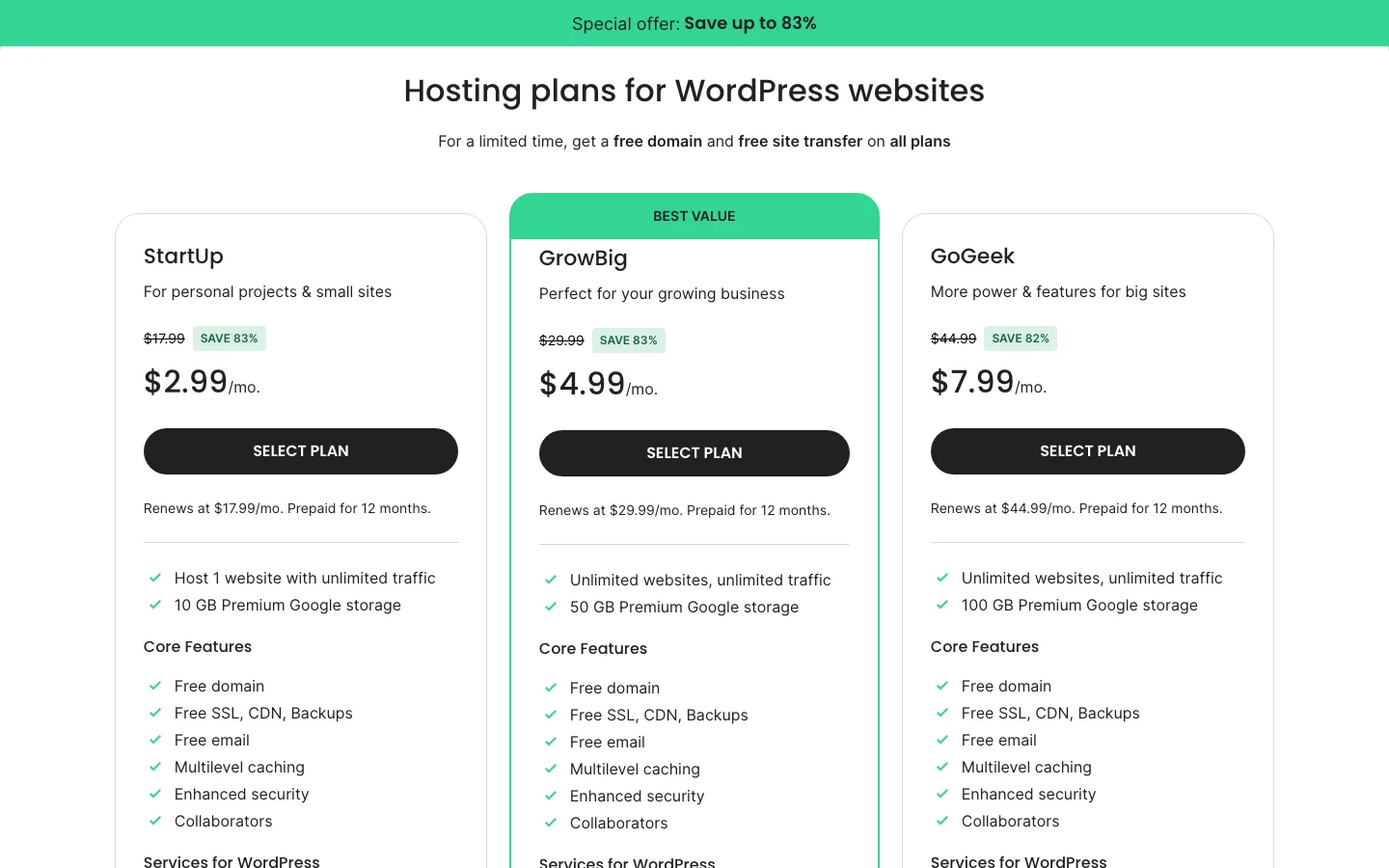
SiteGround plans
SiteGround sells three shared plans for WordPress. The intro price needs a 12-month prepay and applies to the first invoice only. After that you pay SiteGround’s standard rates, which it publishes in its knowledge base and says have applied since September 7, 2023.
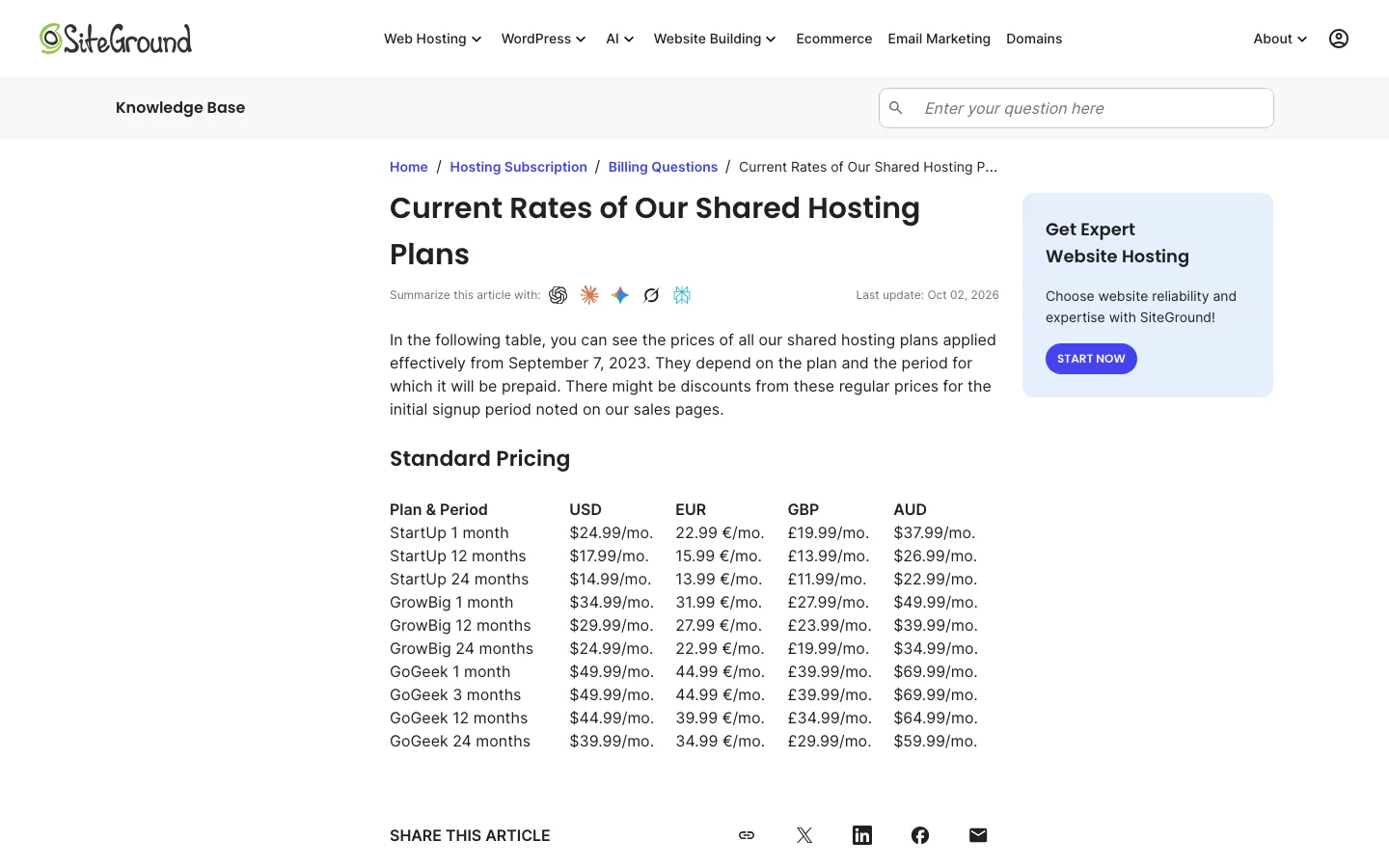
SiteGround’s “Current Rates of Our Shared Hosting Plans” page, last updated. These are the prices you pay after the first term.
SiteGround StartUp costs $35.88 for the introductory year, equivalent to $2.99 monthly. It renews at $17.99 monthly on one year or $14.99 on two, while month-to-month billing is $24.99. It allows one site, 10 GB and a suggested 10,000 monthly visits.
GrowBig costs $59.88 initially at $4.99 monthly, then $29.99 on one-year renewal or $24.99 on two; monthly billing is $34.99. It allows unlimited sites, 50 GB and roughly 100,000 visits. GoGeek costs $95.88 initially at $7.99 monthly, then $44.99 or $39.99, with month-to-month billing at $49.99, unlimited sites, 100 GB and roughly 400,000 visits.
SiteGround’s terms say plans renew automatically for the same period you last bought, at “the then current renewal fees”, and that it charges 15 days before a 12-month term ends. You can switch to a 24-month renewal in the Client Area to bring StartUp down to $14.99 a month. Its WooCommerce plans have the same names and prices. If you outgrow shared hosting, SiteGround’s cloud plans start at $100 a month for 4 CPU cores, 8GB of memory and 40GB of storage.
WP Engine plans
WP Engine now sells three plans: Essential (shared servers), Core (isolated servers, from $400 a month) and Enterprise (custom). Most readers will choose Essential and pick a capacity step.
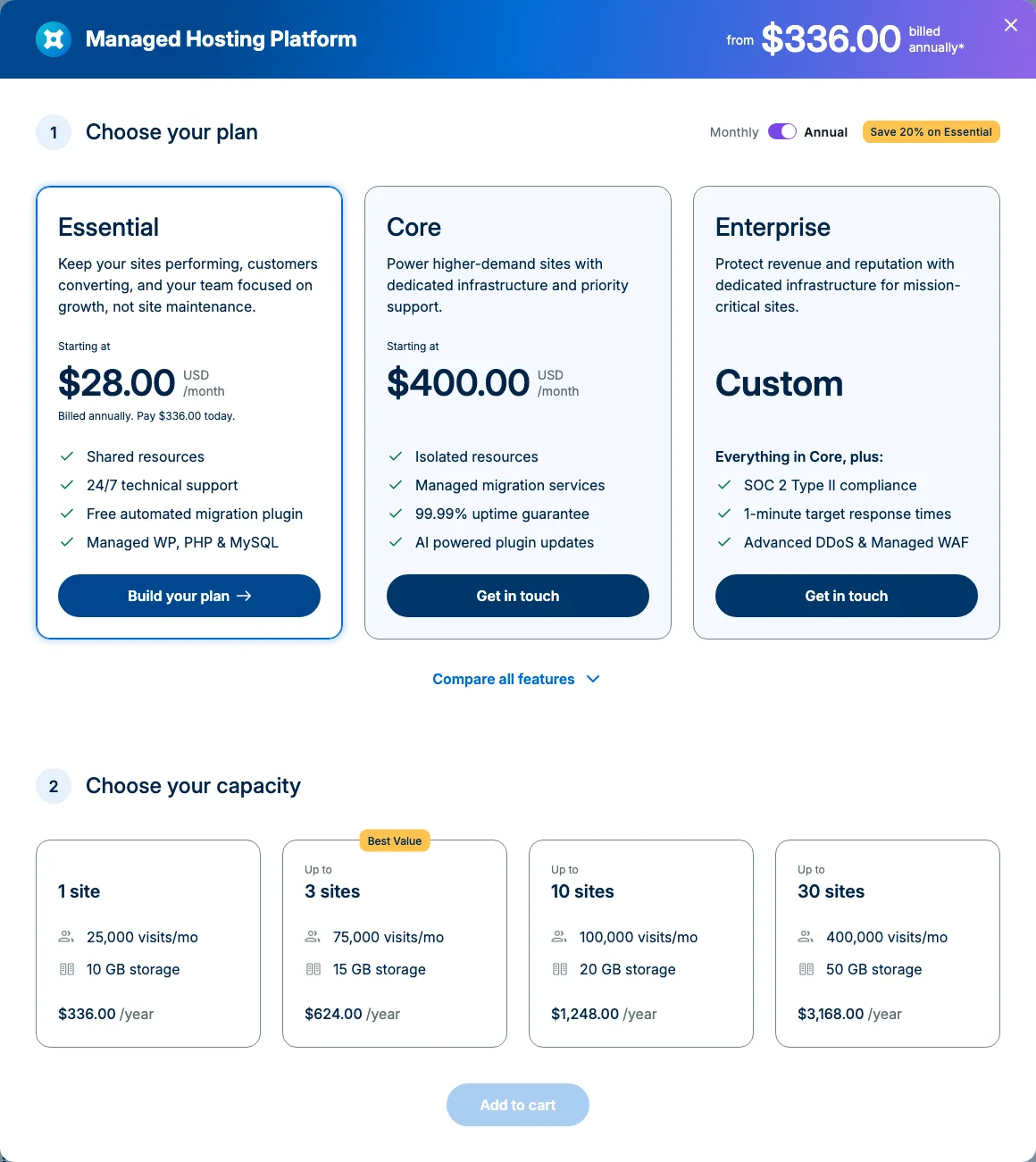
WP Engine’s plan builder on annual billing. The yearly prices include a 20% first-year coupon for new customers.
WP Engine’s single-site Essential plan costs $35 monthly or $336 in the first annual term, renewing at $420, with 25,000 visits and 10 GB. The three-site tier costs $65 monthly, $624 initially or $780 at annual renewal, with 75,000 visits and 15 GB.
The ten-site tier costs $130 monthly, $1,248 initially or $1,560 at renewal, with 100,000 visits and 20 GB. The 30-site tier costs $330 monthly, $3,168 initially or $3,960 at renewal, with 400,000 visits and 50 GB.
The fine print under the plan builder says first-year pricing is for new customers buying Essential only, is not valid for renewals, and that “product renewal pricing subject to change”. The listed regular annual price equals 12 monthly payments. Each extra site costs $20 a month, and every Essential step includes 75GB of bandwidth a month.
What you pay in years one, two and three
This assumes you buy each plan on a yearly term and renew yearly at the listed price. Taxes are extra at both hosts.
For one site across three years, SiteGround StartUp costs $35.88 initially plus two renewals at $215.88, totaling $467.64. WP Engine’s single-site plan costs $336 initially plus two years at $420, totaling $1,176.
For up to three sites, GrowBig totals $779.64 from $59.88 plus two years at $359.88; WP Engine totals $2,184 from $624 plus two years at $780. For up to ten sites, GoGeek totals $1,175.64 from $95.88 plus two years at $539.88; WP Engine totals $4,368 from $1,248 plus two years at $1,560.
SiteGround’s renewal is the bigger jump (StartUp goes from $2.99 to $17.99 a month, six times the intro price), but WP Engine still costs more in every year and at every size. If you renew StartUp for 24 months after year one, three years of SiteGround cost $395.64. The plans are not identical: WP Engine’s prices include three environments per site and a stronger SLA, and SiteGround’s sites share one plan’s server resources. But the gap is wide enough that most small sites will not miss what WP Engine adds.
Traffic limits and overage fees
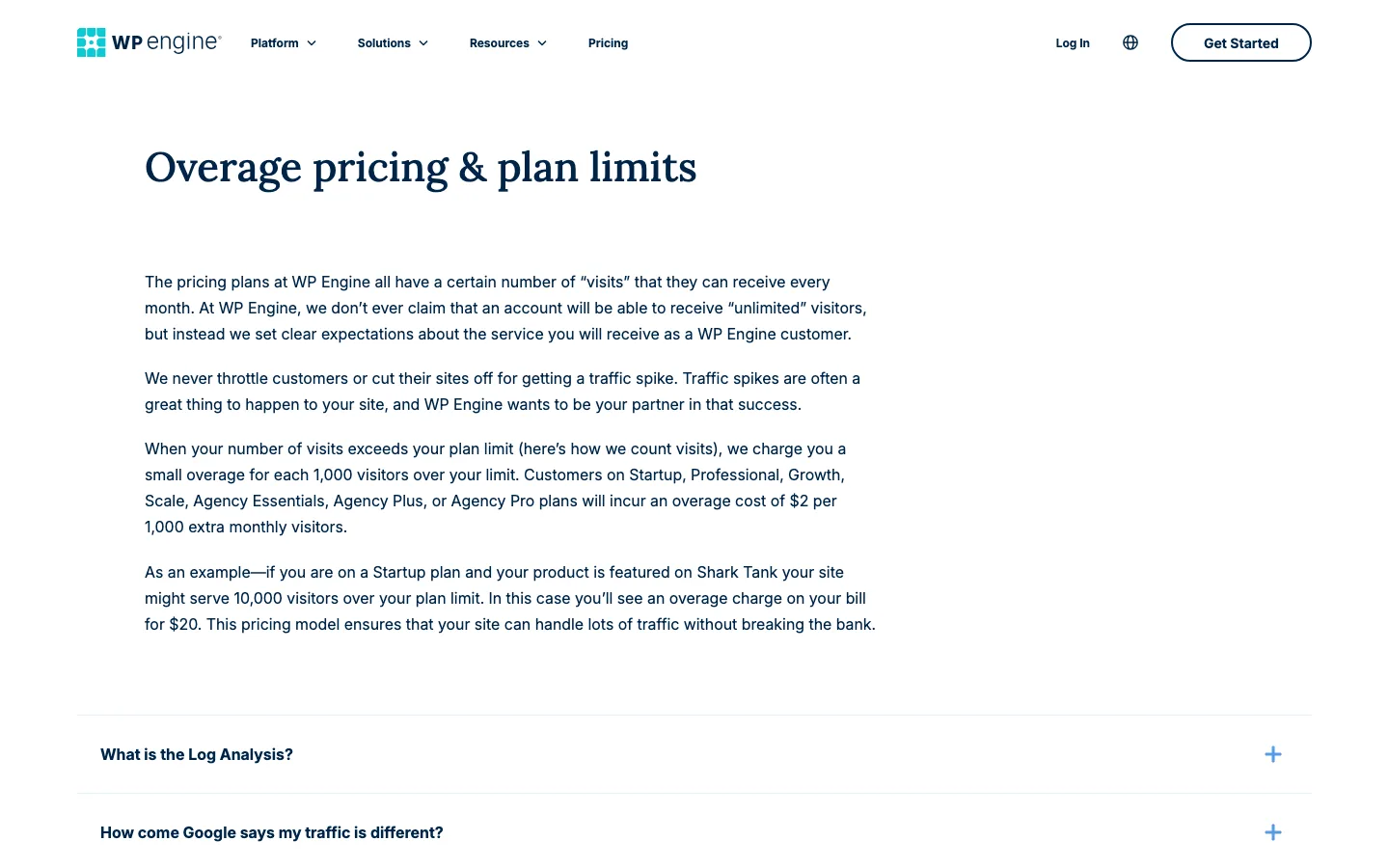
WP Engine’s overage pricing page. It still uses the old plan names (Startup, Professional, Growth, Scale), which match today’s 1, 3, 10 and 30-site steps.
The two hosts limit traffic in different ways.
WP Engine counts visits: one unique IP address in a 24-hour period, with bots excluded. If you go over your plan’s limit, it keeps your site online and charges $2 per 1,000 extra visits, billed monthly even on annual plans. For example, a 1-site plan that gets 35,000 visits in a month is 10,000 over its 25,000 limit, so you pay an extra $20 that month.
SiteGround does not charge per visit. Its plans list unmetered traffic “as far as none of the hosting plan’s resources limitations are reached”, meaning CPU, memory and file limits. The visit figures (about 10,000, 100,000 and 400,000 a month) are what SiteGround calls a point of reference when sites use its built-in caching, not a cap. If your site keeps hitting the plan’s resource limits, the fix is an upgrade, not an overage bill.
For a site with uneven traffic, SiteGround’s model is easier to budget for. For a site that keeps growing, WP Engine’s model makes the cost of growth clearer.
Features: staging, backups, email and tools
SiteGround includes SuperCacher, CDN, email accounts sharing up to 10 GB and a first-year domain. Daily backups are stored elsewhere for 30 days, with on-demand copies and staging from GrowBig and Git on GoGeek. It provides a migration plugin and was advertising free transfers, collaborator accounts on all plans and white-label Site Tools on GoGeek.
WP Engine includes EverCache, Cloudflare CDN, three environments per site, automatic and on-demand backups kept 30 to 60 days, ten premium themes and Genesis Blocks. A migration plugin and transferable sites are included; assisted migrations start on Core. It does not host email, sell domains or host DNS.
SiteGround sells Cloud upgrades and extra AI tokens. WP Engine Essential separately sells tested plugin updates, monitoring, an advanced firewall and NitroPack, so compare the configured bill rather than the base price alone.
Staging. This is WP Engine’s biggest practical advantage. Every site gets up to three environments, so you can test in development, show a client the staging copy, and push to live. SiteGround’s one-click staging needs GrowBig or higher. If you stay on StartUp, a WordPress staging plugin fills the gap.
Email and domains. SiteGround includes both, which saves a small business a separate email bill. WP Engine’s support docs say it does not sell domain names and is not a DNS host, so you need a registrar and an email provider elsewhere.
Migrations. Both offer a free plugin for moving a WordPress site in yourself. SiteGround Migrator has 80,000+ active installs on WordPress.org as of October 2026. If you would rather move the site by hand, our guide to the All-in-One WP Migration plugin works with either host.
Built-in AI. SiteGround now includes a free AI Agent for WordPress and AI Studio Essential on every plan, with 20,000 free AI tokens a month. WP Engine’s AI features (Smart Search AI and a managed vector database) are paid extras.
Speed: what we could measure
We could not benchmark either host’s servers without buying plans, so we timed public pages only. On October 4, 2026, from one location in the US, we measured time to first byte (how long the server takes to start sending a page) with curl, taking the median of 7 requests per page.
WP Engine’s homepage showed its Headless Platform behind Cloudflare and responded in a median 322 ms. Its plans page and blog showed WP Engine behind Cloudflare at 271 and 259 ms.
SiteGround’s pages showed NGINX through Google’s load balancer: 418 ms for the homepage, 424 ms for WordPress hosting and 212 ms for the blog. These distinct pages do not form a controlled comparison of identical customer sites.
This is six pages on one day from one place. It is not a test of the plans you would buy. Both hosts served their own blogs in roughly a quarter of a second, and the slower SiteGround sales pages are heavier marketing pages. Results also move between runs: when we measured siteground.com earlier the same day for our Hostinger comparison, its median was 476 ms.
SiteGround’s own WordPress hosting page says WordPress sites moved from WP Engine to SiteGround in the first half of 2025 loaded 61% faster on average, based on its migrator plugin data. WP Engine, for its part, markets EverCache and its Cloudflare network as built for WordPress speed. Treat both as marketing. Your theme, plugins and images will matter more than the logo on the invoice.
Data centers
- SiteGround runs on Google Cloud in 11 data centers across North America, Europe, Asia and Australia. You pick one at sign-up, and every site on that account lives there. Backups are kept in a separate location from your live site.
- WP Engine puts shared (Essential) plans on Google Cloud in the region closest to you at sign-up. Its docs list 13 Google Cloud locations, including Iowa, South Carolina, Montreal, London, Sydney and Singapore, with Frankfurt, Taiwan and Tokyo marked as premium or extra cost. AWS and Microsoft Azure regions are for premium plans only.
Uptime guarantees: the fine print
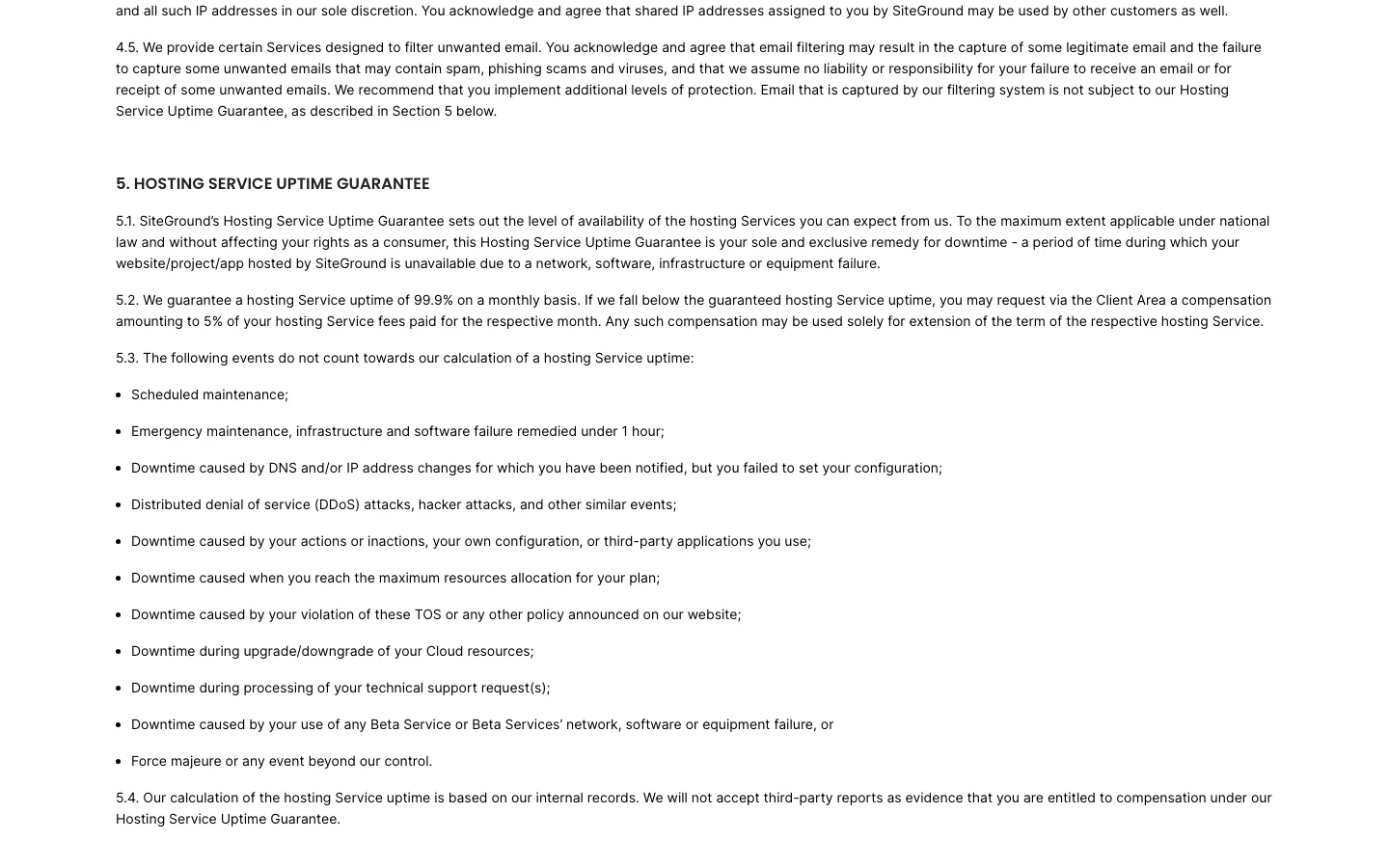
Section 5 of SiteGround’s terms of service. Failures fixed in under an hour do not count toward downtime.
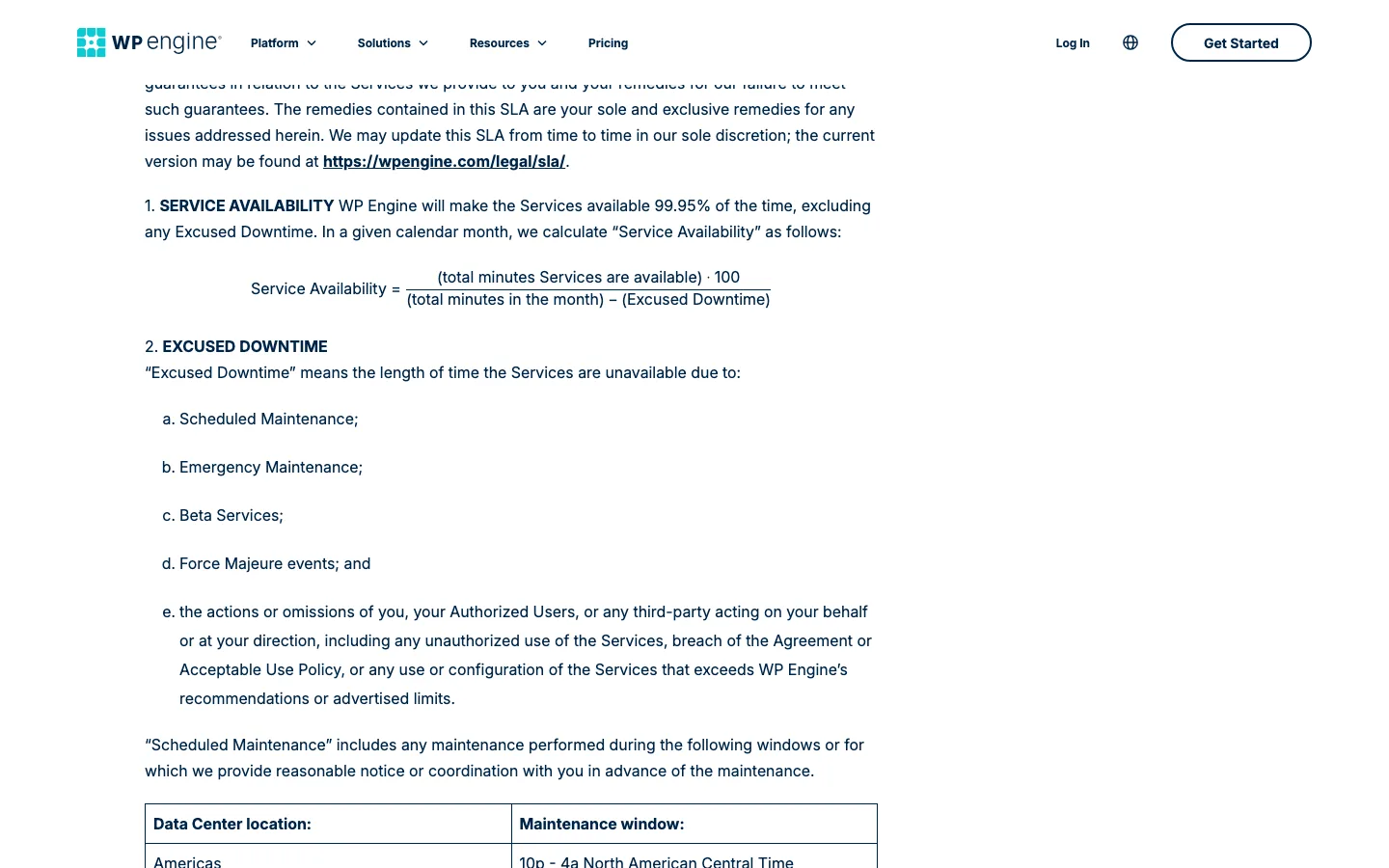
Sections 1 and 2 of WP Engine’s Service Level Agreement.
SiteGround’s 99.9% monthly guarantee offers 5% of the monthly fee as extra hosting time. Its exclusions include scheduled and emergency maintenance, failures fixed within an hour, DDoS attacks and exhausted plan limits. Claims rely on its internal records rather than outside reports.
WP Engine’s standard guarantee is 99.95%, rising to 99.99% on Core and Enterprise, with 5% of the monthly fee for each full hour beyond the target. It excludes scheduled and emergency maintenance and beta services, including its stated 10 p.m.-to-4 a.m. Central Americas maintenance period, and uses its own downtime calculation.
On paper WP Engine’s guarantee is stronger and pays out more often. In practice, neither credit is worth much: 5% of a $17.99 month is about 90 cents. An SLA is a small refund, not insurance.
Support
SiteGround offers 24/7 live chat, phone and tickets on every plan. Its support page says all staff are in-house employees and that more than 90% of questions are solved on first contact. The phone number for your region appears inside your account. GoGeek chats and tickets go to its most experienced agents first.
WP Engine offers 24/7 chat, phone and tickets, but its support docs say phone support “is unavailable for Lite and Startup plans”, and Startup is the old name for the 1-site Essential step. Core is sold with priority support, and Enterprise lists 1-minute target response times.
We could not test response times without accounts. If you want to call someone on a cheap plan, SiteGround is the only one of the two that allows it.
Refunds, renewals and cancellation
SiteGround gives a 30-day money-back guarantee on shared plans (14 days on cloud). A renewal can be refunded in full if you cancel within 30 days of paying and before the new term starts, or minus the first month if it has started. Domain fees are not refundable.
WP Engine does not mention a money-back guarantee on its plans page. Its terms of service, updated January 1, 2026, say fees “are not refundable except as expressly stated herein”. The terms also say plans renew automatically unless you give notice at least 30 days before the term ends, and that if you end a plan early, the remaining fees for the term become due. On an annual plan you are committed for the year, so try the monthly plan first if you are unsure.
Company background
SiteGround was founded in 2004 and says it has been privately owned since. Its standard renewal rates have not changed since September 2023. It is no longer on WordPress.org’s recommended hosting page, which as of October 2026 lists Bluehost, Hostinger and Pressable.
WP Engine hosts only WordPress and owns several well-known WordPress products, including the Genesis Framework, StudioPress themes, Advanced Custom Fields, the Local app and Flywheel. Since October 2024 it has been in a lawsuit with Automattic and Matt Mullenweg. In December 2024 a US court ordered Automattic to stop blocking WP Engine’s access to WordPress.org, and WP Engine says a September 24, 2026 ruling let most of its claims go forward. The case is still open.
Alternatives worth a look
- Kinsta is the closest rival to WP Engine for a single business site. See our Kinsta vs WP Engine comparison, our Kinsta vs SiteGround matchup and the full Kinsta review.
- Flywheel is owned by WP Engine and aimed at designers. Our Flywheel vs WP Engine comparison covers how they differ.
- Cloudways gives you more raw cloud server for the money if you can manage a little more yourself. Read our Cloudways vs SiteGround review and Cloudways review.
- Hostinger costs less than SiteGround to keep over several years. See our Hostinger review.
For a wider shortlist, see our guide to the best managed WordPress hosting, or browse all our WordPress hosting reviews.